Concrete is strong in compression and near-worthless in tension — reinforcing bars carry every tensile force the concrete cannot.
ACI 318-19 strength design: φR_n ≥ U, with U from ACI 5.3.1 (1.2D + 1.6L, …) and material constants f'c, fy, E_c, f_r, ε_cu = 0.003.
Chapter 21 introduces the two constituent materials of reinforced concrete — concrete (f'c) and deformed reinforcing steel (fy) — their stress–strain behaviour, ACI 318-19 strength-design framework (φR_n ≥ U), the ACI 5.3.1 load combinations, cover/durability, and the time-dependent effects (creep, shrinkage) that dominate long-term deflections.
Iconic steel structures built on engineering excellence
ACI 318 established
1936
Unified strength design
1971
ACI 318-19 (current)
2019
Load pathService D + L (ASCE 7)ACI 5.3.1 combos → UStrain profile (ε_cu = 0.003)Nominal capacity R_nφR_n ≥ U (φ from Table 21.2.2)Detail cover per Table 20.5.1.3
02
Learning objectives
What you will be able to do after finishing Chapter 1 — and why each objective matters in practice
Objective 01
Interpret f'c and fy
f'c is the specified 28-day compressive strength (4,000–6,000 psi typical for buildings; up to 19,000+ psi for tall-building lower columns). Grade 60 rebar has fy = 60 ksi — the U.S. default.
E_c controls deflection; f_r sets cracking moment M_cr.
Where it is used
Ch. 24 serviceability, Ch. 26 slenderness.
Connects to
ACI 318-19 §19.2.2.1 and §19.2.3.1.
Objective 04
Understand rebar & bond
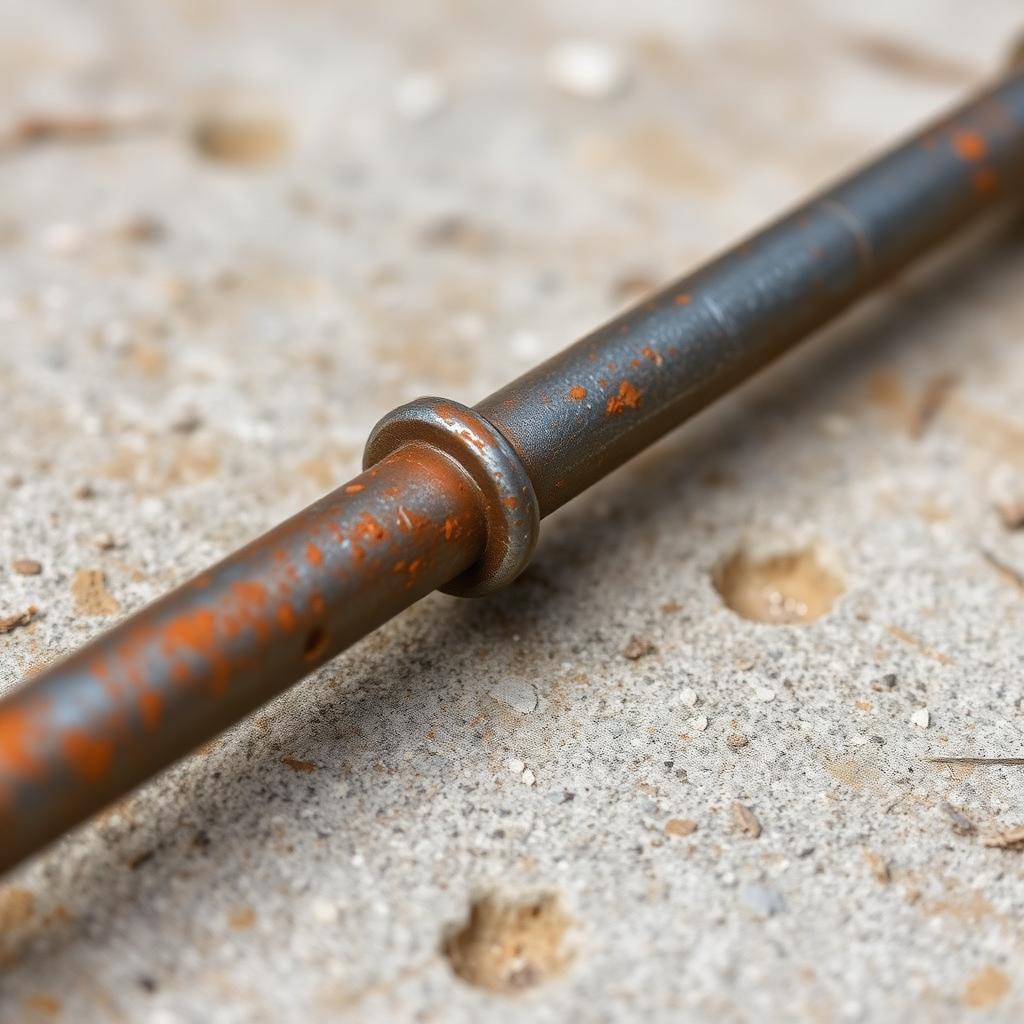
Deformed bars (ASTM A615/A706) rely on mechanical interlock from rolled-on ribs. Grade 60 is standard; Grade 40, 75, 80 also exist. Every bar carries mill/size/type/grade markings.
Why it matters
Bond makes composite action possible and sets development length ℓ_d.
Where it is used
Ch. 25 development & splices.
Connects to
ACI 318-19 §25.4; ASTM A615 / A706.
Objective 05
Apply φR_n ≥ U
Strength-design inequality with φ from ACI Table 21.2.2: 0.90 tension-controlled (ε_t ≥ 0.005), 0.65 tied compression-controlled, 0.75 spiral, 0.75 shear/torsion.
Why it matters
The single unifying safety inequality in ACI 318.
Where it is used
Every strength check in every RC chapter.
Connects to
ACI 318-19 §5.3, Table 21.2.2.
Objective 06
Cover & durability
ACI Table 20.5.1.3: 3/4 in for interior slabs (#11 and smaller, no exposure); 1-1/2 in for beams/columns exposed to weather; 3 in cast against and permanently exposed to earth.
Why it matters
Cover — not concrete strength — protects the rebar from corrosion.
Where it is used
Detailing on every drawing.
Connects to
ACI 318-19 §20.5.
Objective 07
ACI 5.3.1 load combinations
1.4 D · 1.2 D + 1.6 L + 0.5(L_r|S|R) · 1.2 D + 1.6(L_r|S|R) + (L or 0.5 W) · 1.2 D + 1.0 W + L + 0.5(L_r|S|R) · 1.2 D + 1.0 E + L + 0.2 S · 0.9 D + 1.0 W · 0.9 D + 1.0 E.
Why it matters
Produces the factored demand U that every strength check must exceed.
Where it is used
Every RC design.
Connects to
ACI 318-19 §5.3.1 (from ASCE 7-22 §2.3.1).
Objective 08
Recognise creep & shrinkage
Shrinkage occurs whether the member is loaded or not (drying); creep occurs only under sustained compressive load and can double the immediate elastic strain over years.
Why it matters
Long-term deflections and prestress losses are dominated by creep/shrinkage.
Where it is used
Ch. 24 serviceability, prestressed concrete.
Connects to
ACI 318-19 §24.2.
03
Engineering motivation
What each part of a steel-frame building actually does — and why it exists
Before you design any single member, you have to see the whole system. A steel-frame building is not a collection of independent shapes bolted together — it is a deliberate load path, engineered so that every kilonewton of gravity, wind, or seismic demand has a continuous route from where it starts to the ground where the earth can resist it.
The photograph below shows a typical steel framing detail. Drag each labelled chip onto the structural element it names — the drop is only accepted when it lands inside the correct element's outlined region. A correct answer locks in with a green outline and a short explanation; a wrong answer flashes the region red, tells you what you actually hit, and returns the chip so you can try again. Press Reveal expected placements to see the reference solution (that attempt is then marked as assisted).
Fig. 1.3 · Drop a chip inside the outlined element it names. Green = correct and locked; red flash = wrong element, chip returns.
04
Failure mechanisms
Why we design the way we do — six ways steel structures have failed, and what each disaster taught the profession
Every provision in AISC 360 is a scar. Behind each equation, load factor, and detailing rule is a bridge, a walkway, or a tower whose failure cost lives and rewrote the profession. The six case studies below trace the mechanisms that motivate the code you are about to learn.
Read each one as an engineer, not a spectator: identify the load, the limit state, the missing check, and the specific clause that exists today because that check was missed. When you meet those clauses again in Chapters 5–17, they will read as answers, not rules.
Case 01
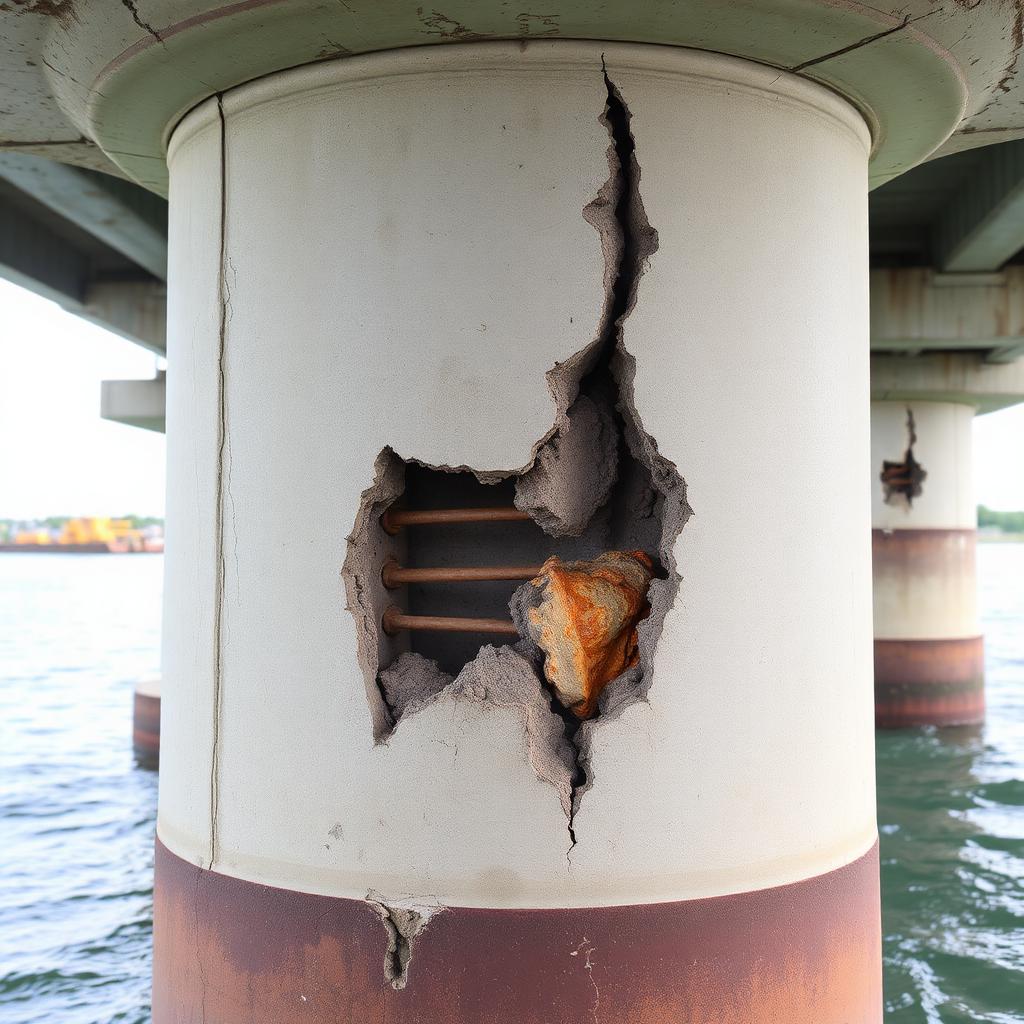
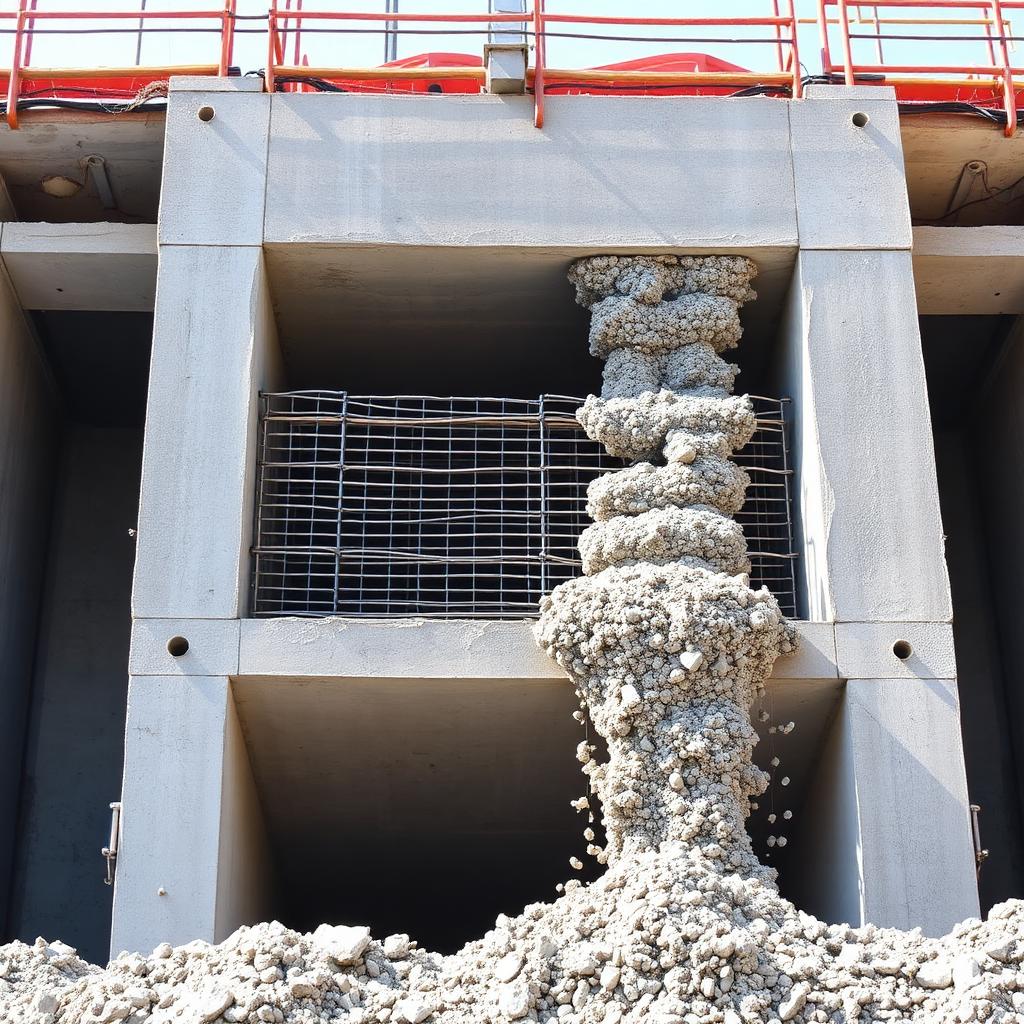
Fig. 1.4.1 · Spalling from inadequate cover
Failure mechanism
Spalling from inadequate cover
Chloride ingress corrodes the rebar; rust occupies 2–6× the volume of the parent steel and pops the cover concrete off.
Root cause
Cover thinner than ACI Table 20.5.1.3 for the exposure category.
Lesson learned
Use the ACI cover table, not the minimum you can get away with. Cover is cheap; repair is not.
§ACI 318-19 §20.5
Case 02
Fig. 1.4.2 · Plain concrete brittle failure
Failure mechanism
Plain concrete brittle failure
A plain concrete beam snaps in one crack at first flexural tension; no ductility, no warning.
Root cause
Concrete tensile strength ≈ 10% of f'c and it fails at very small strain — no reserve.
Lesson learned
Provide As ≥ As,min so the section carries more after cracking than before (ACI §9.6.1).
§ACI 318-19 §9.6.1
Case 03
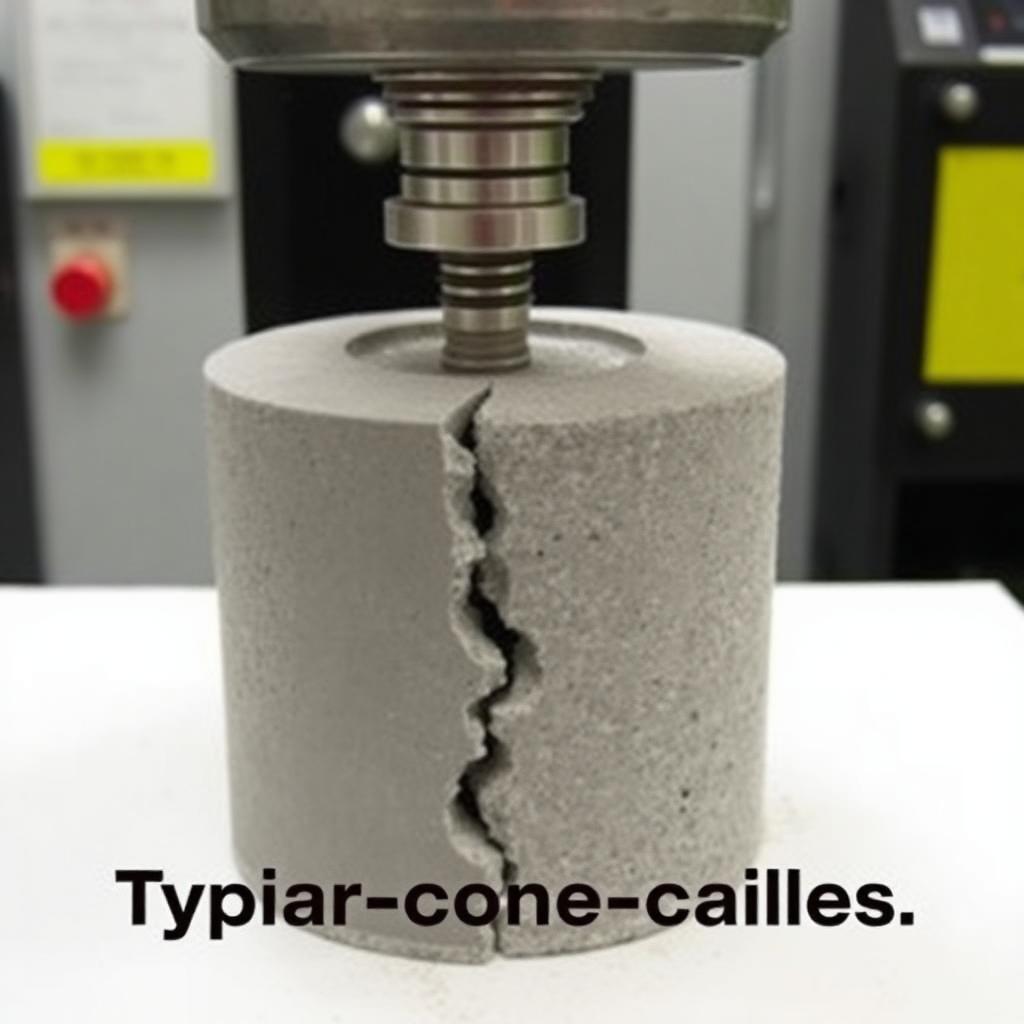
Fig. 1.4.3 · Cylinder-test cone failure
Failure mechanism
Cylinder-test cone failure
Standard 6×12 in (or 4×8 in) cylinder loaded in a compression machine fails on a diagonal cone at f'c.
Root cause
Unconfined concrete under uniaxial compression → shear-cone rupture near the peak.
Lesson learned
Confinement (ties/spirals) or lateral compression raises capacity dramatically — the basis for column design.
§ASTM C39; ACI 318-19 §19.2
How failure propagates
The five-stage failure progression
1Service D + L applied
2Ru assembled by ACI 5.3.1
3Concrete cracks in tension at f_r
4Rebar picks up tension, strain grows
5Steel yields at ε_y = 0.00207 (Gr 60)
6Concrete crushes at ε_cu = 0.003
Design codes intervene at the transition from yield to instability. Everything before yield is elastic and reversible; everything after instability is a race to collapse. LRFD keeps the demand well below the first transition.
05
Lecture notes
The full textbook chapter — figures, equations, and engineering narrative
Reflection · Think before you read
Concrete is strong in compression but weak in tension; steel is the opposite. Why does bonding them together produce a composite far more useful than either alone — and what happens at the interface when that bond fails?
1.1 What is Concrete? What is Reinforced Concrete?
Concrete is a mixture of sand, gravel, crushed rock (or other aggregates) held together by a paste of Portland cement and water. Admixtures may be added to modify workability, durability, early strength, or set time. Like most rock-like materials, concrete has high compressive strength but very low tensile strength. Reinforced concrete pairs concrete with embedded steel reinforcing bars so the steel carries the tensile forces the concrete cannot.
Concrete = coarse aggregate + fine aggregate (sand) + cement paste, with rebar taking over wherever tension develops.
Plain vs reinforced concrete under a point load — the same beam that snaps brittlely in plain concrete carries load ductilely once rebar is added.
1.2 Advantages of Reinforced Concrete as a Structural Material
High compressive strength per unit cost compared to nearly every other structural material.
Fire and water resistance. Concrete cover shields the rebar from ordinary fires — after a typical fire the surface spalls but the structural core is intact.
Rigidity. RC frames deflect and vibrate far less than steel or timber frames of equal span.
Low maintenance and long service life. Concrete strength increases with age (continued hydration of the cement paste).
Cast into any shape. Slabs, shells, arches, domes, folded plates — anything the formwork can hold.
Uses inexpensive local materials. Only the cement and rebar need to be shipped in; sand and gravel are usually local.
Lower-skill labor. Placing and finishing concrete needs a less specialized crew than a structural-steel erection team.
1.3 Disadvantages — and Their Practical Consequences
Very low tensile strength → reinforcing is mandatory wherever bending, shear, or restraint tension develops.
Formwork is expensive. Formwork and shoring can be one-third to two-thirds of the total cost of an RC structure — so economizing formwork (repeat bays, standard depths, flat soffits) is where most cost savings come from.
Heavy dead load. Low strength per unit weight → members get large, and dead-load moments dominate long spans. Lightweight aggregates can help.
Large member sizes reduce clear headroom and useable floor area, matters for tall buildings.
Property variability. Field-mixed/placed concrete varies more than shop-fabricated steel — mix design, curing, and inspection matter.
Shrinkage & creep. Long-term deformations from water loss and sustained load — see §1.11 below.
1.5 Concrete vs Structural Steel — When to Pick Which
Consideration
Favors Reinforced Concrete
Favors Structural Steel
Height
Low to mid-rise; increasingly competitive over 20 stories
Traditionally > 20 stories, though RC now competes
Notable RC records: the 74-story, 859-ft Water Tower Place (Chicago) — tallest RC building for many decades; the 1,465-ft CN Tower (Toronto) — tallest RC structure. Roughly 9 of 10 U.S. buildings are 3 stories or less and under 15,000 ft², where RC and steel are both viable choices.
1.6 Compatibility of Concrete & Steel
Bond. Concrete adheres chemically to bar surfaces; deformations (ribs) rolled onto rebar force mechanical interlock. Slippage is negligible under service loads.
Corrosion protection. The alkaline concrete cover passivates the steel — as long as the cover is intact and chlorides are kept out, the steel does not corrode.
Thermal compatibility. α_steel ≈ 6.5×10⁻⁶/°F, α_concrete ≈ 4–7×10⁻⁶/°F (avg ~5.5). Because they expand almost the same amount, temperature changes don't shear the bond apart.
Fire. Cover keeps rebar below its critical temperature — a 1½-in cover typically buys a 1-hour rating for beams.
1.10 Admixtures — Tuning the Concrete
Admixture
What it does
When to use
Air-entraining (ASTM C260/C618)
Introduces microscopic air bubbles; freeze–thaw & deicing-salt resistance
Any exterior slab, pavement, or freeze-exposed member
Accelerating (e.g. calcium chloride)
Faster early strength gain; earlier form removal
Cold weather. Never with embedded aluminum, galvanized forms, or prestressed steel — corrosion risk (ACI 3.6.3).
Retarding (acids, sugars)
Slows set; keeps concrete plastic longer
Hot weather; long pours; architectural exposed-aggregate finishes
Superplasticizer (organic sulfonates)
Very high workability at low w/c — either lower water or higher strength at same water
Not a substitute for dense, well-cured concrete — treat as insurance only
1.11 Properties of Concrete
a) Compressive strength f'c
Determined at 28 days on standard 6×12-in cylinders (or 4×8-in). Typical values:
Concrete class
f'c (psi)
Typical use
Ordinary
3,000 – 4,000
Beams, slabs, footings, walls
Prestressed
5,000 – 6,000
Precast/PT beams, bridge girders
High-strength
8,000 – 19,000+
Lower-story columns of tall buildings
Because the actual placed concrete varies, the mix must be designed for a higher average strength f'cr > f'c (see ACI §5.3). This is the overdesign factor a mix designer applies to hit the specified value reliably.
Family of concrete stress–strain curves (f'c = 2–6 ksi). Key observations: (a) linear only up to ~⅓ to ½ f'c, (b) peak stress near ε ≈ 0.002, (c) ACI assumes crushing at εcu = 0.003, (d) weaker concretes are less brittle (larger failure strain).
b) Static Modulus of Elasticity Ec
Concrete has no single "the" modulus — the curve is nonlinear. ACI adopts a secant modulus taken from the origin to the point ≈ 0.45f'c (roughly the service-load stress):
General form (ACI §19.2.2)
(1)
Ec=wc1.5⋅33⋅fc′(psi)with90≤wc≤155lb/ft3
Normal-weight simplification (wc ≈ 145 pcf)
(2)
Ec=57,000⋅fc′(psi)=4,700⋅fc′(MPa)
Quick numbers (f'c = 4,000 psi, normal-weight): Ec = 57,000·√4,000 ≈ 3,605 ksi. Compare with steel: Es = 29,000 ksi — steel is ≈8× stiffer.
c) Modulus of Rupture (tensile cracking stress)
ACI §19.2.22.2
(3)
fr=7.5⋅λ⋅fc′(psi)
Quick number: f'c=4,000 psi → fr ≈ 474 psi — only ~12% of f'c, and ~130× smaller than fy of Grade-60 rebar. That gap is the whole reason we reinforce.
d) Shrinkage — water leaving hardened concrete
Fresh concrete needs more mixing water than the cement actually consumes (called hydration). The excess water evaporates over time and the paste contracts — the concrete shrinks and often cracks. Shrinkage continues for years but roughly 90% occurs in the first year. To limit it: (1) use the lowest workable water content, (2) cure well, (3) place in small pours with construction joints, (4) use shrinkage reinforcement (temperature & shrinkage steel — see the one-way slab chapter), (5) prefer dense, low-absorption aggregates.
e) Creep — deformation under sustained load
Under long-term compressive load, concrete keeps deforming after the instantaneous elastic shortening. This time-dependent extra strain is called creep (or plastic flow). Final creep is typically 2–3× the initial elastic deformation, and ~75% of it occurs in the first year. Practical consequence (Ch. 6): long-term deflections of RC beams are 2–3× short-term deflections — which is why ACI applies a multiplier to sustained-load deflections.
Shrinkage vs creep on a log-time axis. Shrinkage happens whether the member is loaded or not; creep only under sustained compressive load.
f) Tensile strength — small, brittle, but critical
Concrete's tensile strength is only about 8% – 15% of f'c. The tensile strength does not vary linearly with f'c; it varies approximately with √f'c. Direct axial tension tests are impractical (grip stress concentrations, alignment problems), so two indirect tests are used: the modulus-of-rupture flexure test and the split-cylinder test.
Why don't we rely on concrete tension in design? Concrete cracks at such small tensile strain that the co-existing stress in the rebar would be tiny — so far below fy that using it would be uneconomical. Once cracking occurs, the concrete has essentially no tensile strength and the rebar carries all of it. That is why the flexure and shear derivations you'll see next intentionally set the concrete tensile contribution to zero.
Third-point flexural test — plain concrete beam, span L, loaded to first bottom-face crack.
ACI's code value from hundreds of such tests: fr = 7.5·λ·√f'c (psi) — the same expression already introduced above.
Split-cylinder test — compressive P is applied along the length of the cylinder; failure occurs by a tensile split down the vertical diameter.
Split-cylinder tensile strength
(5)
fct=2P/(π⋅L⋅D)
g) Shear strength — never measured in "pure" shear
"Pure" shear is nearly impossible to isolate in the lab because normal stresses always develop. Reported concrete shear strengths range from ⅓ to 4/5 of f'c — a huge scatter. In design (Ch. 7), you'll see Vc written as a conservative multiple of √f'c, not a fraction of f'c, precisely to sidestep that scatter.
1.12 Aggregates & Lightweight Concrete
Aggregates occupy about ¾ of the concrete volume, so aggregate properties dominate concrete cost, workability, and strength. Fine aggregate passes a No. 4 sieve (¼″ openings); coarser material is coarse aggregate.
Maximum aggregate size (ACI 26.7.22.1(a)(1)) must not exceed:
⅕ of the narrowest form dimension,
⅓ of the depth of the slab, or
¾ of the minimum clear spacing between reinforcing bars.
Larger stones can be used only if the engineer is satisfied no honeycomb or voids will result. Aggregates must be strong, durable, clean — dust or clay coating destroys the paste-to-aggregate bond.
Lightweight modifier λ. Because lightweight concrete has lower tensile capacity, ACI reduces every √f'c term by λ. Linear interpolation is allowed between the tabulated values, or if the average splitting tensile strength fct is known:
(6)
λ=fct/(6.7⋅fc′)≤1.0
λ affects fr, Vc, coefficient of friction (shear-friction), and development length ℓd — a single factor that ripples through every RC chapter.
1.13 High-Strength Concrete (HSC)
Concretes with f'c > 6,000 psi are called high-strength (or high-performance) concretes. Modern ready-mix trucks routinely deliver 9,000 – 10,000 psi, and lab mixes above 20,000 psi have been achieved. Landmark project: Two Union Square, Seattle, at 19,000 psi.
Where it pays off: lower stories of tall building columns (loads up to 1,000+ kips), precast/prestressed girders, shear walls, offshore & long-span structures.
What drives strength: low water–cement ratio (aided by superplasticizers), silica fume, well-graded strong & rough coarse aggregate, careful curing.
Cost/benefit rule of thumb (from McCormac): a 12,000–15,000 psi mix costs ≈ 3× a 3,000 psi mix but delivers 4–5× the strength — favorable for column sizes and prestressed members.
Design implications: β1 decreases with f'c (see the flexure chapter), so extra strength does not translate linearly into extra moment capacity. Also more brittle → detailing rules tighten.
1.14 Fiber-Reinforced Concrete (FRC)
Adding 1–2 % by volume of discrete fibers (steel, glass, plastic, or synthetic) does not significantly raise the compressive strength — instead it dramatically increases toughness, crack-width control, impact resistance, and fatigue life. Rebar reinforces in one direction; fibers reinforce in all directions, which is why FRC is popular for slabs on grade, industrial floors, shotcrete linings, thin shells, and pavements.
Property
Typical range
Fiber length
0.25 – 3 in
Fiber diameter
0.01 – 0.03 in
Aspect ratio ℓ/d
25 – 150 (≈100 average)
Volume dose
1 – 2 % of concrete volume
Steel fibers are most common (durable when protected by cover). Glass fibers must be alkali-resistant — ordinary glass deteriorates in cement paste. Toughness improvements are measured with ASTM C1018 third-point beam loading.
1.15 Concrete Durability
In many projects the compressive strength is dictated by durability, not by structural demand. ACI 318 Ch. 19 imposes exposure categories that limit w/c, require entrained air, and set minimum f'c:
Reinforcement is supplied as plain or deformed bars (welded wire fabric is also used). Deformed bars — with rolled-on ribs — are used almost everywhere; plain bars are used only for spiral wrapping in columns. In the U.S. bar numbers equal eighths of an inch of nominal diameter: #4 = 4/8″ = 0.5″, #8 = 1″. Standard sizes are #3–#11, plus large sizes #14 and #18.
Grade
Minimum fy
εy = fy/Es
Where used
Grade 40
40 ksi (300 MPa)
0.00138
Older / small work
Grade 50
50 ksi (350 MPa)
0.00172
Some ties, stirrups
Grade 60 (default)
60 ksi (420 MPa)
0.00207
Almost all ordinary RC
Grade 75 / 80 / 100
75 – 100 ksi (520 – 700 MPa)
0.00259 – 0.00345
Heavily loaded columns/walls, special detailing
Bar cross-sectional areas — memorize the top row. #n bar area (in²) ≈ π·(n/16)² (check yourself: #8 → π·(0.5)² = 0.785, matches the tabled 0.79 in²).
Table 1.1 — Reinforcement Bar Sizes and Areas (inch-pound & soft-metric)
Bar No.
Diameter (in.)
Area (in²)
SI Bar No.
Diameter (mm)
Area (mm²)
3
0.375
0.11
10
9.5
71
4
0.500
0.20
13
12.7
129
5
0.625
0.31
16
15.9
199
6
0.750
0.44
19
19.1
284
7
0.875
0.60
22
22.2
387
8
1.000
0.79
25
25.4
510
9
1.128
1.00
29
28.7
645
10
1.270
1.27
32
32.3
819
11
1.410
1.56
36
35.8
1006
14
1.693
2.25
43
43.0
1452
18
2.257
4.00
57
57.3
2581
1.18 SI Bar Sizes & Material Strengths (ACI 318M)
Bar numbers in ACI 318M = bar diameter in millimeters, rounded (so #10 ≈ 9.5 mm, #13 ≈ 12.7 mm — see Table 1.1 above).
Yield strengths fy: 300, 350, 420, 520 MPa — the metric equivalents of Grades 40, 50, 60, and 75.
In marine, deicing-salt, or industrial chloride environments the alkaline cover eventually breaks down and rebar corrodes. Corrosion products occupy ~2–3× the original steel volume, spalling the cover and destroying bond. ACI §20.5.1 requires increased cover, tighter w/c limits, and mix additives. Additional lines of defense:
Epoxy-coated bars (ASTM A775) — handled carefully so the coating isn't chipped; development lengths must be lengthened (ψe factor in Ch. 7).
Dual-coated bars (A1055) — zinc under epoxy, added to ACI 318 in 2011.
Cathodic protection — sometimes retro-fitted to parking-garage slabs.
1.20 Identifying Marks on Reinforcing Bars
Every deformed bar carries four rolled marks. Learn to read them on site — a substituted grade or wrong bar size is a code violation waiting to happen.
ASTM standard rolled-on markings — every deformed bar carries mill, size, steel type, and grade.
Field-inspection checklist.
Bar size number matches the drawing schedule.
Grade lines / number match the specification (usually Gr 60).
Type letter matches: S for A615 in most gravity work; W for A706 in seismic (special moment frames, R > 3).
No rust flakes, oil, mud, or damaged epoxy coating.
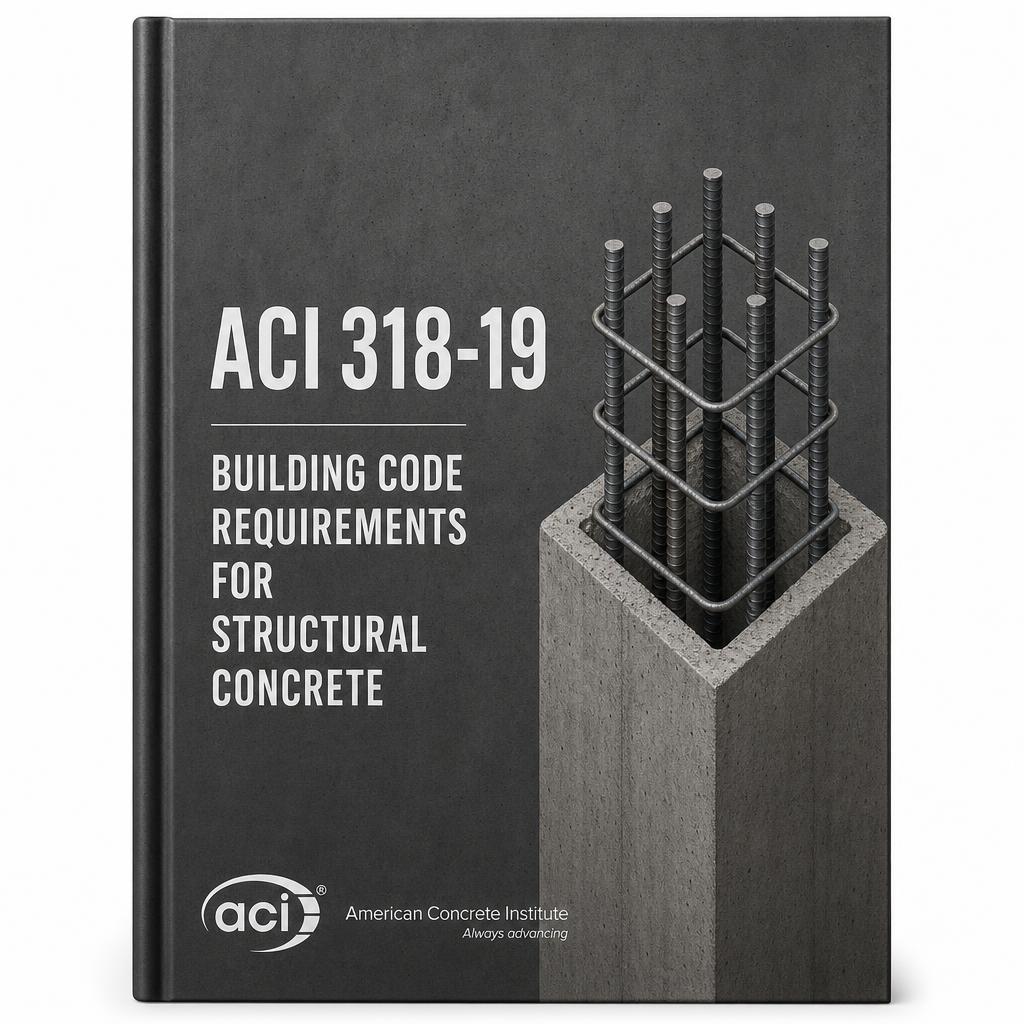
📘 ACI 318-19 — the code you will live by
ACI 318-19 — Building Code Requirements for Structural Concrete (companion standard for every RC chapter)
Every equation in the next five chapters comes from ACI 318-19. Learn to navigate it: chapter numbers are stable across editions — Ch. 5 load combinations, Ch. 9 beams, Ch. 10 columns, Ch. 19 concrete properties (Ec, fr), Ch. 21 strength-reduction factors φ, Ch. 22 sectional strength, Ch. 25 anchorage and development.
Mn vs φMn — do not confuse these.
Mn (nominal) = the strength the section can theoretically carry using specified material properties (f'c, fy). Computed from strain compatibility. It is not the design capacity.
φMn (design) = the strength the code allows you to count on. Always < Mn. This is what you compare with the factored demand Mu.
Design check: φMn ≥ Mu. If you write Mn ≥ Mu, you have skipped safety.
Same rule applies to shear (φVn ≥ Vu), axial (φPn ≥ Pu), and torsion — always insert φ before comparing.
⚠ Chapter 21 Takeaways You Must Not Forget
Concrete carries compression; rebar carries tension. Never expect concrete alone to survive tension.
f'c is measured at 28 days on standard cylinders. Do not confuse mix design f'cr with specified f'c.
ACI assumes concrete crushes at εcu = 0.003 (Ch. 22). This drives every flexure/column derivation.
Ec = 57,000·√f'c is a secant modulus for normal-weight concrete only. Use the wc1.5·33 form for lightweight.
Long-term deflections ≈ 2–3× short-term deflections because of creep & shrinkage — check both.
Always design with φ (strength reduction) — never compare Mn, Vn, or Pn directly to the factored demand.
06
Professional practice, safety & ethics
Concrete materials practice
Professional practice
•Specify f′c, exposure class, maximum w/cm, and rebar grade — not just strength.
•Require mix designs and trial batches for review; acceptance is by ACI 318 Ch. 26 strength criteria.
•Coordinate concrete strength gain with formwork stripping and post-tensioning schedules.
Safety in design & construction
•Formwork and shoring failures during placement are the leading cause of concrete construction fatalities.
•Cold and hot weather placement require documented procedures; strength results are meaningless without proper curing.
•Never accept 'the cylinders were mishandled' as a substitute for an investigation.
•Do not approve water added on site to improve workability without a mix-design check.
•Report failing test results to the owner and building official.
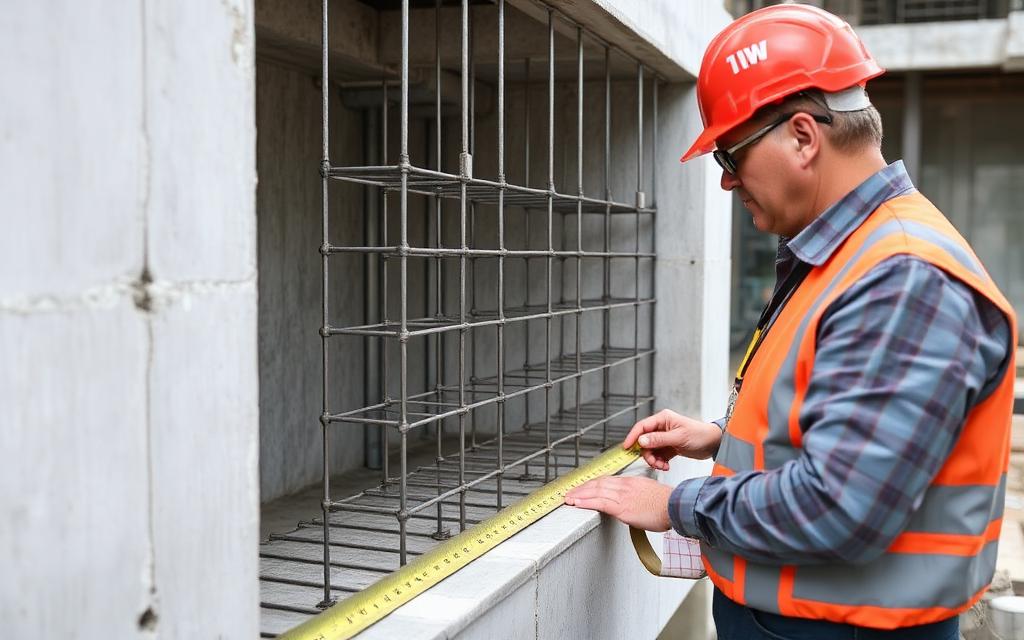
Field inspection: rebar size, spacing, and cover verified before placement.Design review: documenting assumptions before the drawings are sealed.
ABET / licensure link. These points map to ABET Student Outcomes 2 and 4 — engineering design within realistic constraints, and recognition of ethical and professional responsibilities. Expect NCEES FE and PE exam questions on the NSPE Code of Ethics, OSHA construction requirements, and the engineer's standard of care.
07
Cost analysis
Concrete material cost
Approach
•Concrete is cheap per volume; formwork and reinforcement labor dominate the installed cost of an RC element.
•Raising f′c from 4,000 to 6,000 psi typically adds only 8–12% to the concrete price but can shrink members appreciably.
•Rebar is priced per ton installed — congestion increases placement labor sharply.
Worked cost example — Installed cost breakdown of 1 yd³ of RC beam
Basis: US average unit rates
Line item
Qty
Rate
Cost
Ready-mix concrete, 4,000 psi
1 yd³
$165
$165
Formwork (contact area)
55 ft²
$10
$523
Reinforcing steel installed
0.09 ton
$2,200
$198
Placement, finishing, curing
1 yd³
$95
$95
Estimated total
$981
Takeaway. Formwork is over half the cost — repeating the same beam size beats optimizing each one.
Unit rates are representative US averages for teaching purposes. On a real project, price with current local rates (RSMeans, fabricator quotes, or contractor pricing) and state the estimate date.
08
Animated concepts
Key mechanics visualised — watch the strain profile, stress block, or buckled shape evolve
Uncracked → cracked RC section
Once tensile stress at the extreme fibre exceeds fr, the section cracks and the neutral axis moves up — steel takes all tension (Icr governs).
09
Engineering figures
Full-page reference diagrams — the visual vocabulary you will use for the rest of the course
§21.6.1
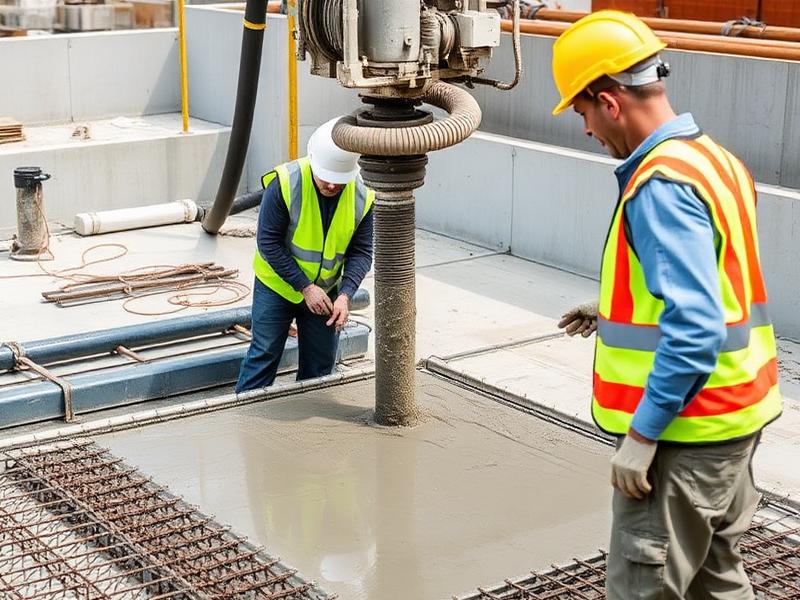
Pour in progress
Fig. 21.1RC beam pour
Rebar cage + fresh concrete = composite member.
§21.6.2
Cylinder test (ASTM C39)
Fig. 21.2Cylinder failure
f'c is defined by the 28-day cylinder strength.
§21.6.3
Deformed bar
Fig. 21.3Rib deformations
Ribs give the mechanical interlock that develops bond.
§21.6.4
Cover spalling
Fig. 21.4Cover spalled off
Loss of cover exposes rebar to corrosion — Table 20.5.1.3 fixes minimums.
10
Worked examples
Full textbook solutions — problem, theory, step-by-step, verification, interpretation
Example 21.1
Compute E_c, f_r, and ε_y for an RC beam (Grade 60 · f'c = 4,000 psi)
Establish the three material constants that ACI 318-19 uses in every downstream flexure, shear, and deflection check.
Problem statement
A rectangular RC beam is being sized. Establish the material constants used by ACI 318-19:
Determine the modulus of elasticity Ec, the modulus of rupture fr, and the yield strain εy. Confirm that tension-controlled behaviour (φ = 0.90) is achievable.
FIG. 21.1 — f'c is defined by the 28-day compressive strength of a 6×12 in (or 4×8 in) cylinder tested per ASTM C39.DIMWhitney equivalent stress block — a uniform 0.85·f'c stress over depth a = β1·c, with the ACI-assumed extreme-fibre strain εcu = 0.003.
Deformed rebar with the ACI-adopted Es = 29,000 ksi.
Cylinder strength f'c based on standard 28-day ASTM C39 test.
Code references
ACI 318-19 §19.2.2.1
ACI 318-19 §19.2.3.1
ACI 318-19 §20.2.2.2
ACI 318-19 §22.2.2.1
ACI 318-19 Table 21.2.2
Theory & approach
ACI 318-19 idealises concrete as elastic up to about 0.45·f'c with a secant modulus Ec, then non-linear to the peak, then softening to the assumed crushing strain εcu = 0.003. Its very low tensile strength is captured by the modulus of rupture fr, used only for cracking-moment (Mcr) and deflection calculations — never as a design flexural strength. Rebar is treated as elastic-perfectly-plastic with Es = 29,000 ksi and yield stress fy.
The three constants below feed every downstream RC chapter: Ec → deflection; fr → Mcr; εy → tension-controlled boundary check.
Step-by-step solution
1
Step 1 — Given
f'_c = 4,000 psi
fy = 60,000 psi
Es = 29,000 ksi
λ = 1.0 (normal-weight concrete)
2
Step 2 — Modulus of elasticity E_c
ACI Eq.ACI 19.2.2.1
Ec = 57,000·√f'_c (psi, normal-weight)
√f'_c = √4,000 = 63.246
Ec = 57,000 · 63.246
Ec = 3,604,997 psi
Ec ≈ 3,605 ksi
3
Step 3 — Modulus of rupture f_r
ACI Eq.ACI 19.2.3.1
fr = 7.5·λ·√f'_c (psi)
fr = 7.5 · (1.0) · √4,000
fr = 7.5 · 63.246
fr ≈ 474 psi
4
Step 4 — Yield strain ε_y
HookeACI 20.2.2
εy = fy / Es
εy = 60,000 / 29,000,000
εy = 0.00207
5
Step 5 — Compare with ε_cu
εcu = 0.003 (ACI §22.2.2.1)
εcu = 0.003 > εy = 0.00207
Steel yields well before concrete crushes, so a tension-controlled section is achievable when the tensile strain at nominal strength εt ≥ 0.005 (Table 21.2.2).
Plugging f'c in ksi into Ec = 57,000·√f'c — the constant 57,000 is calibrated for f'c in psi.
Forgetting the λ factor in fr for lightweight concrete (λ = 0.75 all-LW, 0.85 sand-LW).
Using Es = 30,000 ksi (steel-design habit) instead of the ACI-adopted 29,000 ksi.
Confusing εy (yield strain in the steel) with εcu (crushing strain in the concrete).
References
· ACI 318-19
11
Guided practice
Compute the governing variables — hints unlock as you need them
For f'c = 4,000 psi (NWC) and Grade 60 rebar, compute ε_ty and 0.85·f'c.
Your turn
Hints
1.ε_ty = f_y / E_s — this is the yield strain used to bound tension-controlled sections (ACI §21.2.2).
12
Independent practice
Solve the chapter's design task — compute each governing variable
Design task
For normal-weight concrete with f'c = 5000 psi and Grade-60 reinforcement, compute the ACI 318 modulus of elasticity Ec, the Whitney-block factor β1, and the tension-controlled yield strain εty.
Given
f'c = 5000 psi (NWC)
fy = 60,000 psi
Es = 29,000,000 psi
Approach
Ec = 57,000·√f'c (psi) — ACI 318 §19.2.2.
β1: 0.85 for f'c ≤ 4000; then reduced 0.05 per 1000 psi over 4000, but not less than 0.65.
εty = fy / Es.
Submit your answer
13
Mini design challenge
Pick the minimum ACI 318 cover for each exposure condition
Brief
Pick minimum ACI Table 20.5.1.3 cover for three situations: (a) interior one-way slab with #5 bars, (b) beam exposed to weather with #8 bars, (c) footing cast against and permanently exposed to earth.
Requirements
Cite ACI 318-19 Table 20.5.1.3 for each case
State whether the member is cast against soil, exposed to weather, or interior
Note when cover must be increased for corrosive environments (ACI §20.5.1.4)
Explain how cover ties to fire rating and bond development
These questions reference ACI 318-19 — sections, equations, and tables are cited explicitly. Use a calculator. Each question offers a clue you may reveal before answering. Submissions are recorded to your account once signed in.
RC21-1ACI 318-19 §19.2.2.1
1. Modulus of elasticity of normal-weight concrete with f'c = 4,000 psi (ACI Eq. 19.2.2.1.b, w_c = 145 pcf):
RC21-2ACI 318-19 §19.2.3.1, Eq. 19.2.3.1
2. Modulus of rupture fr for normal-weight concrete with f'c = 4,000 psi:
RC21-3ACI 318-19 Table 22.2.2.4.3
3. β1 for the equivalent stress block when f'c = 6,000 psi:
RC21-4ACI 318-19 Table 21.2.2
4. φ for a tension-controlled flexural section (Gr 60):
RC21-5ACI 318-19 §22.2.2.1
5. Ultimate compressive strain of concrete assumed by ACI at the extreme compression fiber:
Attach your handwritten or typed step-by-step solution for this chapter's graded quiz. The instructor can download every submission. PDF only, up to 25 MB.
How your upload will be graded
Your file — PDF, Word document, scanned handwriting or a photo — is read page by page like an experienced structural engineering instructor would. The scan is validated first, then your reasoning, structural model, calculations, diagrams, code basis and final answers are graded on process, not just the final number. Design work is additionally reviewed against AISC 360-22 and ACI 318-19. Partial credit applies, and one early mistake carried correctly forward is only penalized once.
Before you attach the file
Include every page, in order and right way up — a missing page cannot earn credit.
Keep margins in frame: nothing cropped at the edges, especially boxed final answers.
Scan or photograph in good, even light — no shadows, glare or blur; 300 dpi or a steady phone scan.
Write in dark pen; faint pencil is the most common 'UNREADABLE — INSTRUCTOR REVIEW REQUIRED' flag.
Include all diagrams, FBDs, shear/moment diagrams and section sketches — label them.
Number each question the same way the assignment does, and note anything you skipped.
Show units on every line and box your final answers.
Combine everything into ONE file (PDF preferred; Word, JPG or PNG accepted) under 20 MB.
Sign in to upload your worked solution.
16
FE exam preparation
NCEES-style practice with timer, equation sheet, and mastery tracking
 Objective 01