Engineering story
Chapter 10 · Plate Girders
Built-up I-sections, tension-field action, stiffener design.
A real project narrative for this chapter will be authored as this chapter migrates to the v3.0 structured schema.
Built-up I-sections, tension-field action, stiffener design.
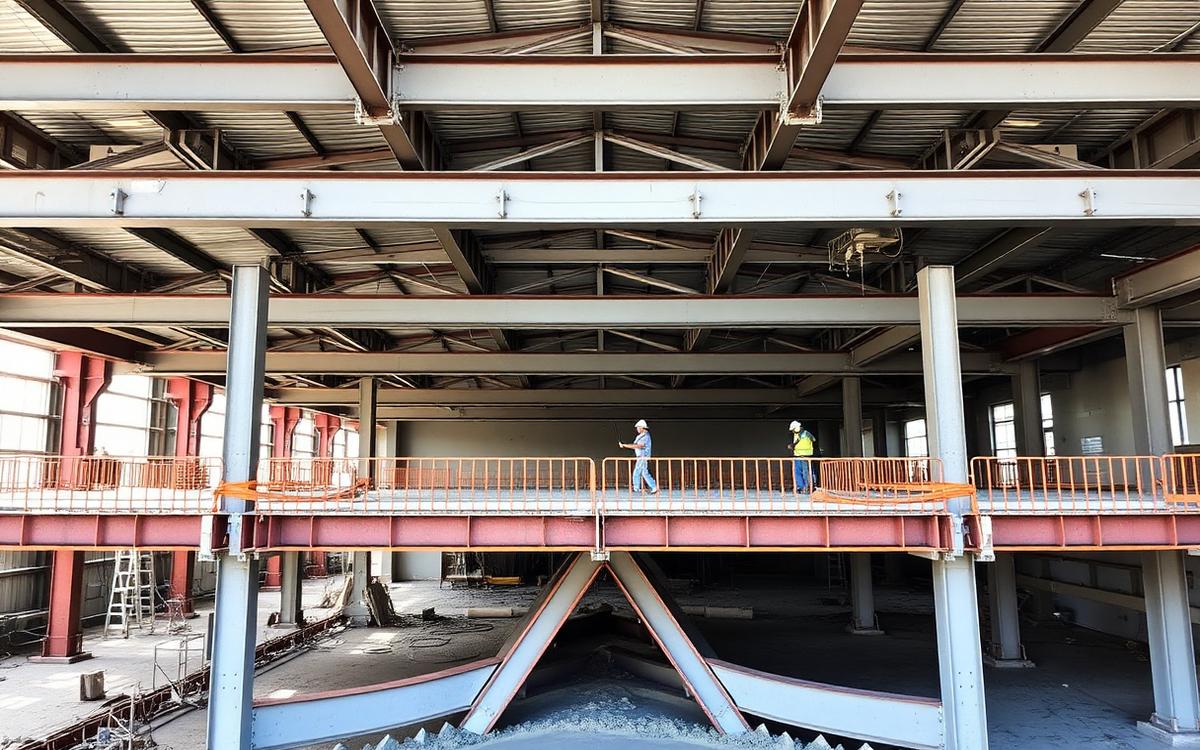
Built-up I-sections, tension-field action, stiffener design.
A real project narrative for this chapter will be authored as this chapter migrates to the v3.0 structured schema.
Photographs and lessons-learned case studies for this topic will be added during chapter migration.
When a rolled W-shape is not deep enough, a built-up I-girder is welded from plates. Plate girders open up tension-field action, stiffener design, and flange-web proportioning issues that don't arise in rolled shapes.
Long-span bridge girders, industrial crane runways, and heavy-transfer girders in commercial buildings.
Use this reference to flip directly to the correct page of the AISC 360-22 Specification while solving problems in this course chapter.
| § | Section title | Page |
|---|---|---|
| F5 | Doubly Symmetric I-Shapes with Slender Webs (Plate Girders) | 16.1-70 |
| F13 | Proportions of Beams and Girders (Flange/Web Proportions) | 16.1-90 |
| G2.2 | Tension-Field Action (Post-Buckling Shear) | 16.1-103 |
| G2.3 | Transverse Stiffeners | 16.1-104 |
| J10 | Bearing Stiffener Design | 16.1-146 |
Companion reference: AISC Design Guide 25 — Plate Girders
The AISC Manual's deepest rolled shape is roughly 44 in. A plate girder has no depth limit — 70 in., 96 in., 120 in. webs are routine. Since flexural efficiency scales roughly with depth squared while material scales with depth, going deeper is the cheapest way to buy moment capacity. Fabricate when:
The single classifying parameter is h/tw, compared against the Table B4.1b limits for webs in flexure:
The §F13.2 upper limit exists because an extremely thin web has essentially no out-of-plane stiffness: it will "oil-can" under its own welding distortion, and web fatigue cracking at the stiffener terminations becomes a real durability issue. If you need to exceed it, add a longitudinal stiffener at h/5 from the compression flange, which raises the limit to 0.40E/Fy.
A slender-web member can never reach Mp — the compression portion of the web buckles out of plane and sheds its stress to the compression flange long before the section plastifies. §F5 handles this by capping the strength at first yield (SxcFy) and then applying a further reduction Rpg.
Read Rpg physically: it is the fraction of first-yield moment that survives after the buckled compression web sheds load. It depends on how slender the web is (hc/tw beyond λrw) and on how much web there is relative to the flange (aw). A big, stiff flange (small aw) can absorb the shed stress, so Rpg stays near 1.0. A thin flange over a big web is penalized hard. Typical values run 0.90–0.98.
Note the two things §F5 does not have: no Rpc (that is §F4's noncompact-web factor), and no plastic moment anywhere. φb = 0.90, Ωb = 1.67 throughout.
Do not use ry of the full section. rt models the compression flange plus one-third of the compressed portion of the web acting as an isolated strut — which is the actual buckling mechanism. Because the web is thin, rt is close to bfc/√12, so flange width is your primary LTB control variable. Widening the compression flange from 16 in. to 20 in. buys 25% more Lp at almost no weight penalty relative to the whole girder.
A slender web buckles in shear at a small fraction of its yield strength. But unlike a column, a buckled shear panel does not fail: it re-organizes. The buckled sheet forms diagonal tension bands anchored by the flanges above and below and by the transverse stiffeners on each side, exactly like the diagonals of a Pratt truss. This post-buckling reserve is called tension-field action (TFA), and it typically triples or quadruples the panel shear strength.
Tighter stiffener spacing → smaller a/h → bigger kv → higher shear buckling stress. This is the whole design lever.
TFA is permitted only when all of these hold:
Resistance factors: φv = 0.90, Ωv = 1.67 for plate girders. (The φv = 1.00 value applies only to rolled I-shapes with h/tw ≤ 2.24√(E/Fy).)
Where tension-field action is used, §G2.3 adds a second requirement (Eq. G2-14) proportioning Ist to the actual shear demand and the web/stiffener yield strengths. In practice both are satisfied by a very modest plate — the stiffness requirement almost never governs the plate size; slenderness and fabricator preference do.
A ⁵⁄₁₆ in. web is extremely weak in local bearing. At every support and every large concentrated load, check:
When any of these fails, provide a bearing stiffener (§J10.8). It is designed as a short compression member consisting of the stiffener plates plus an effective strip of web — 12tw at the member end, 25tw at an interior location — with Lc = 0.75h. Fit it to bear (or weld it to develop the force) and clip the corners to clear the web-to-flange weld.
Companion reference: Chapter F13 / G — no dedicated selection tables (built-up sections). In practice, engineers rarely compute every quantity from first principles — the AISC Steel Construction Manual (16th Ed.) tabulates φRn (or Rn/Ω) for every rolled shape so you can pick a member in seconds. Formulas remain essential for understanding, verifying, and for anything the tables do not cover.
Because plate girders are custom-fabricated, the Manual does not tabulate φMn or φVn — you must compute from Chapter F13 (flexure with slender web) and G2.2 (tension-field action) directly. However, two aids help:
| Name | Equation | AISC Ref |
|---|---|---|
| Design strength | φ Rn ≥ Ru | AISC 360-22 B3.1 |
Problem statement. Determine the available flexural strength of the plate girder for compression-flange yielding and lateral-torsional buckling, and verify that the section is slender-web.
Engineering interpretation: the slender web costs only 6.7% of capacity (Rpg = 0.933) — the web is not carrying much moment anyway, so bend-buckling of the web is a modest penalty. Bracing costs far more: going from Lb = 10.5 ft to 20 ft dropped the capacity 11%. That is the classic plate-girder trade: a deep, thin web is very efficient in bending, but the compression flange is a slender strut sitting on a flexible web, so bracing discipline matters more than in a rolled shape.
Problem statement. Determine the available shear strength of an interior panel (a = 200 in.) and of the end panel (a = 100 in.) of the same girder.
Engineering interpretation: tension-field action nearly quadruples the panel shear strength (C = 0.098 → 0.357). That is not a code trick — it is real post-buckling behaviour, verified in hundreds of tests, in which the buckled web sheet acts as a set of diagonal tension bands anchored by the flanges and stiffeners. But the anchorage has to exist. At the end of the girder there is no adjacent panel to pull against, so the code forbids TFA there. The standard detailing response is exactly what we did: bunch the stiffeners near the supports where shear is highest, and spread them out at midspan where moment governs.
Problem statement. Design intermediate transverse stiffeners for the interior panels (a = 200 in.) of the girder, using tension-field action.
Engineering interpretation: notice how small the required Ist is (1.07 in⁴) compared with what any practical plate provides (17.9 in⁴). The stiffness requirement almost never governs; the b/t slenderness limit and the fabricator's minimum practical plate size do. Do not over-think stiffener sizing — but do think hard about stiffener spacing, which directly sets kv and therefore the shear capacity, and about the welding, which sets the fatigue category for a crane-runway or bridge girder.
Problem statement. The end reaction is Ru = 250 kips applied over a bearing length lb = 10 in. Check web local yielding and web local crippling, then design a bearing stiffener if required.
Engineering interpretation: a ⁵⁄₁₆ in. web is a sheet of paper in local bearing — web crippling gives only 68 kips. The bearing stiffener does not "strengthen" the web; it bypasses it, carrying the reaction as a short column directly from the bearing to the top flange. That is why it must be fitted to bear (or welded to develop the force) and why it is checked as a compression member with Lc = 0.75h — the flanges provide partial rotational restraint at both ends.
Each example mirrors the NCEES FE Civil Reference Handbook style: brief givens, a labeled figure, AISC section reference, step-by-step numeric solution, and a single boxed answer.
These questions reference AISC Steel Construction Manual (16th ed.) — sections, equations, and tables are cited explicitly. Use a calculator. Each question offers a clue you may reveal before answering. Submissions are recorded to your account once signed in.
Attach your handwritten or typed step-by-step solution for this chapter's graded quiz. The instructor can download every submission. PDF only, up to 25 MB.
Your file — PDF, Word document, scanned handwriting or a photo — is read page by page like an experienced structural engineering instructor would. The scan is validated first, then your reasoning, structural model, calculations, diagrams, code basis and final answers are graded on process, not just the final number. Design work is additionally reviewed against AISC 360-22 and ACI 318-19. Partial credit applies, and one early mistake carried correctly forward is only penalized once.
Calculator tips coming soon.
Traps coming soon.
Aim for ~3 minutes per FE problem; skip and return to any item that takes longer than 5 minutes.