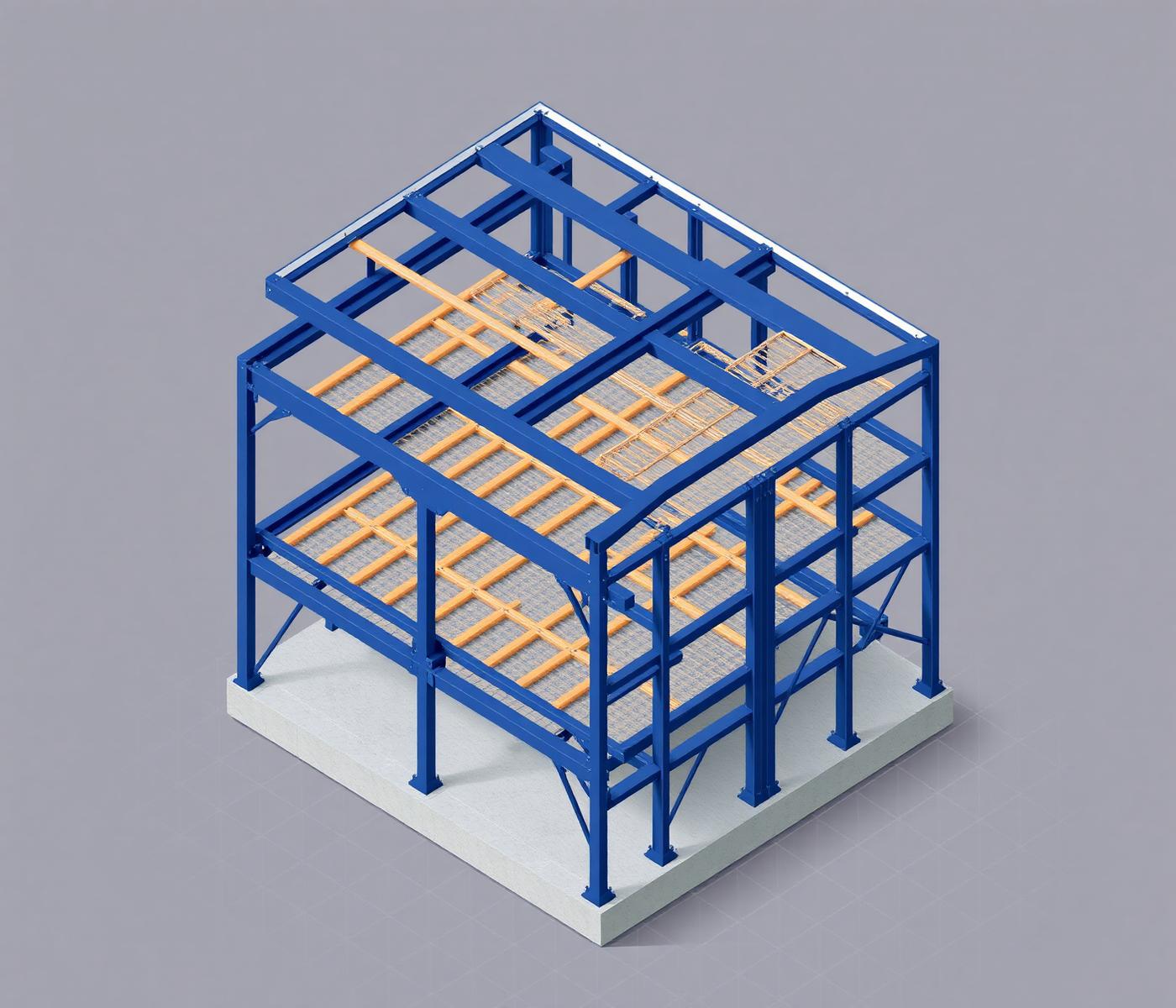
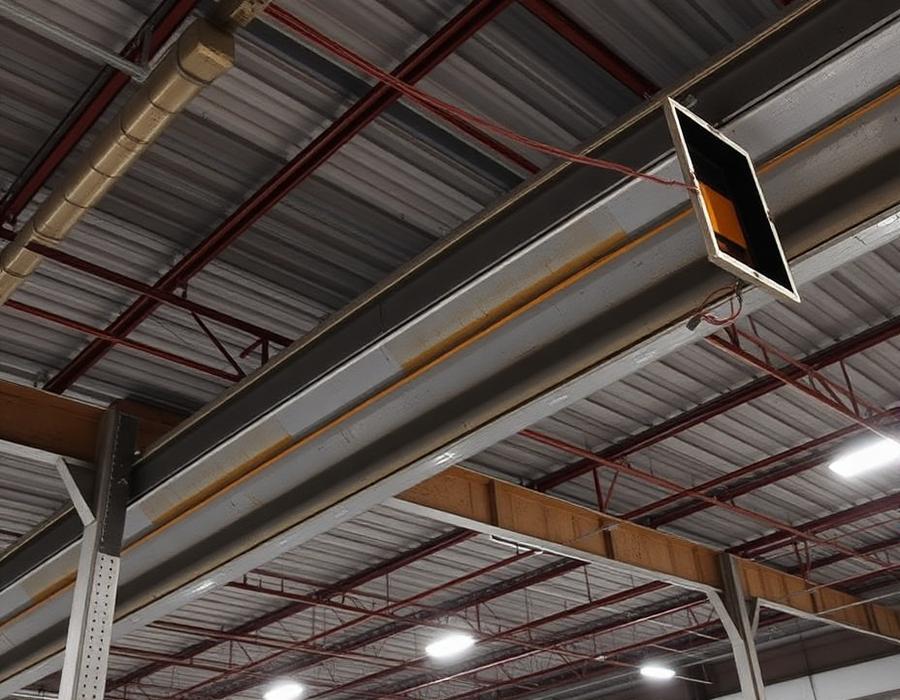
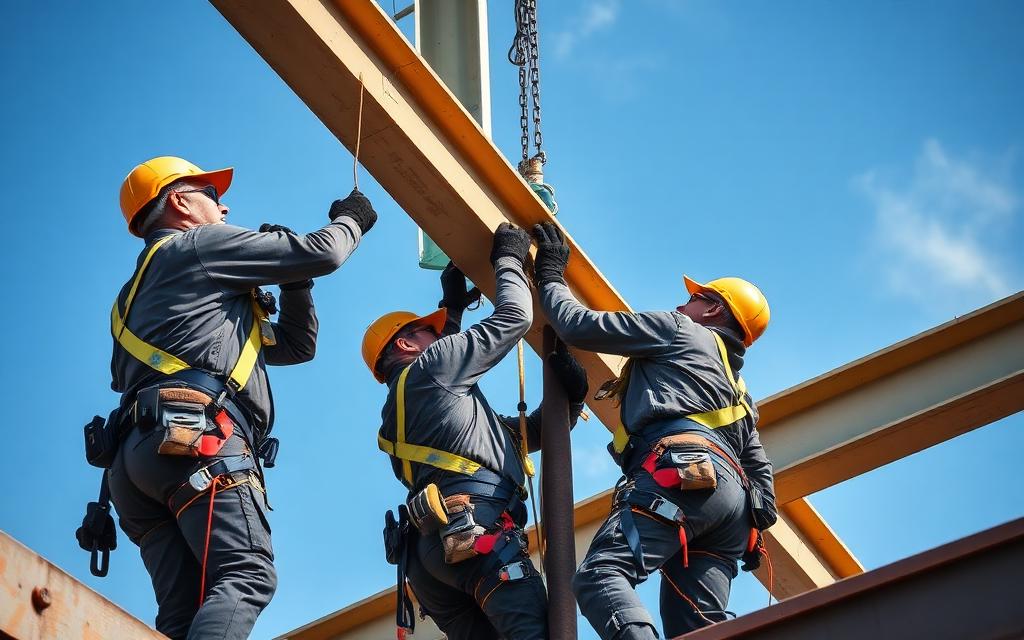
Only sound structural engineering keeps it standing.
This chapter introduces the language, standards, and load path that every steel-designed structure obeys — from a two-bay office frame to a 800-metre tower.
Iconic steel structures built on engineering excellence
Eiffel Tower
Paris1889
Empire State
New York1931
Sydney Harbour Br.
Sydney1932
Sears (Willis) Tower
Chicago1974
Burj Khalifa
Dubai2010
Load pathRoof / SlabBeamGirderColumnFoundation
02
Learning objectives
What you will be able to do after finishing Chapter 1 — and why each objective matters in practice
Objective 01
Analyze structural systems
Recognize frames, trusses, braced frames, and how each carries gravity and lateral loads.
Why it matters
Choosing the right system controls the story height, column grid, and lateral-load resistance of every steel building. A moment frame and a braced frame with identical members can differ in drift by an order of magnitude.
Where it is used
Every schematic-design decision — office towers use moment or braced frames, industrial buildings use trusses, long-span roofs use space frames or arches.
Connects to
Chapters 5 (compression), 6 (flexure), 9 (beam-columns), and 17 (stability) all assume you already know which system you are inside.
Objective 02
Identify steel members
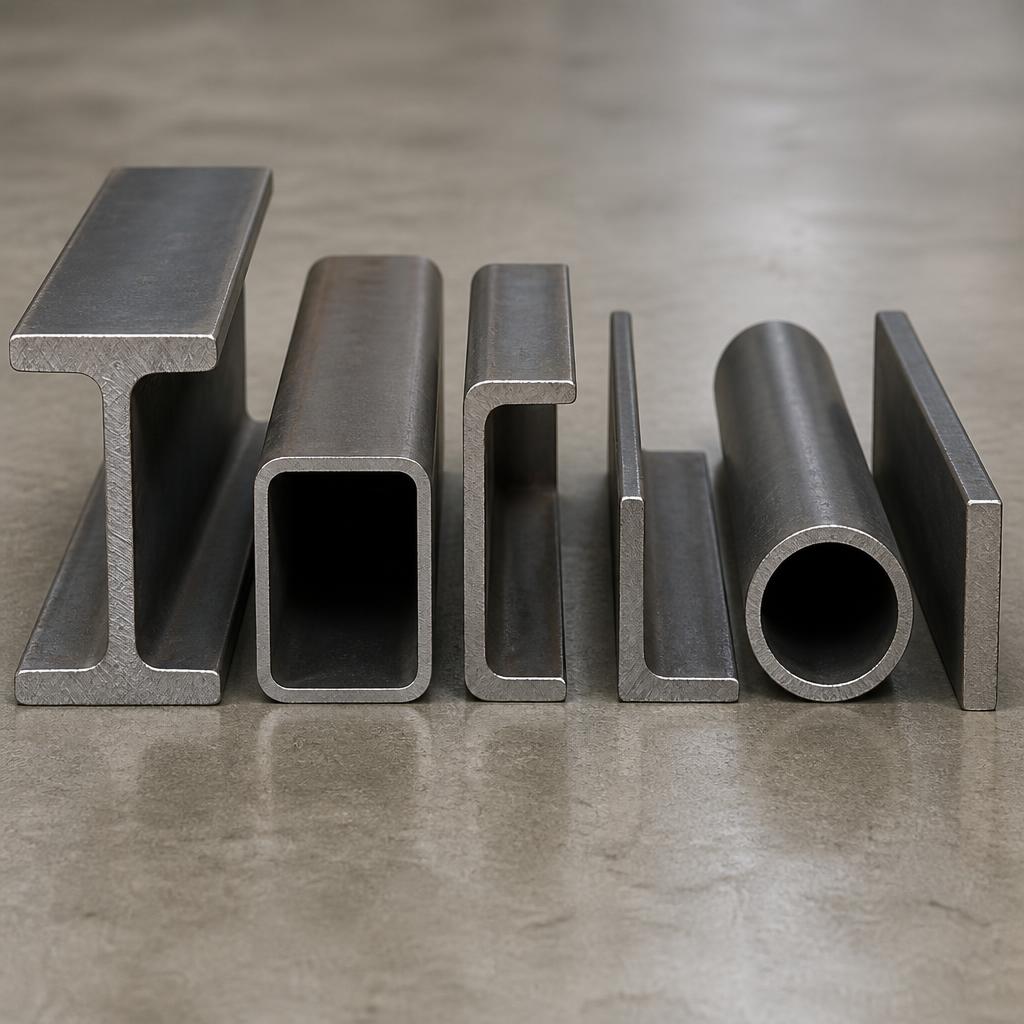
Read W, C, L, HSS, and plate designations and know when each is the right choice.
Why it matters
The shape designation encodes the depth, weight, and — implicitly — the entire cross-section geometry the AISC tables use for design. Misread it and every downstream calculation is wrong.
Where it is used
Every steel drawing calls members out by their AISC designation; every AISC Manual table is indexed by it.
Connects to
Chapter 3 (steel materials & shapes) uses these designations exclusively; Chapters 4–9 all specialize the same shapes to different actions.
Objective 03
Trace load paths
Follow forces from roof to foundation through beams, girders, and columns.
Why it matters
A structure is only as strong as the weakest step in its load path. Skipping this trace is the single most common source of collapse in student and real-world designs.
Where it is used
Framing plans, connection design, and lateral-system layouts all begin with a load-path sketch on section and plan.
Connects to
Chapters 12–16 (connections) exist to keep the load path continuous through every joint.
Objective 04
Cite the standards
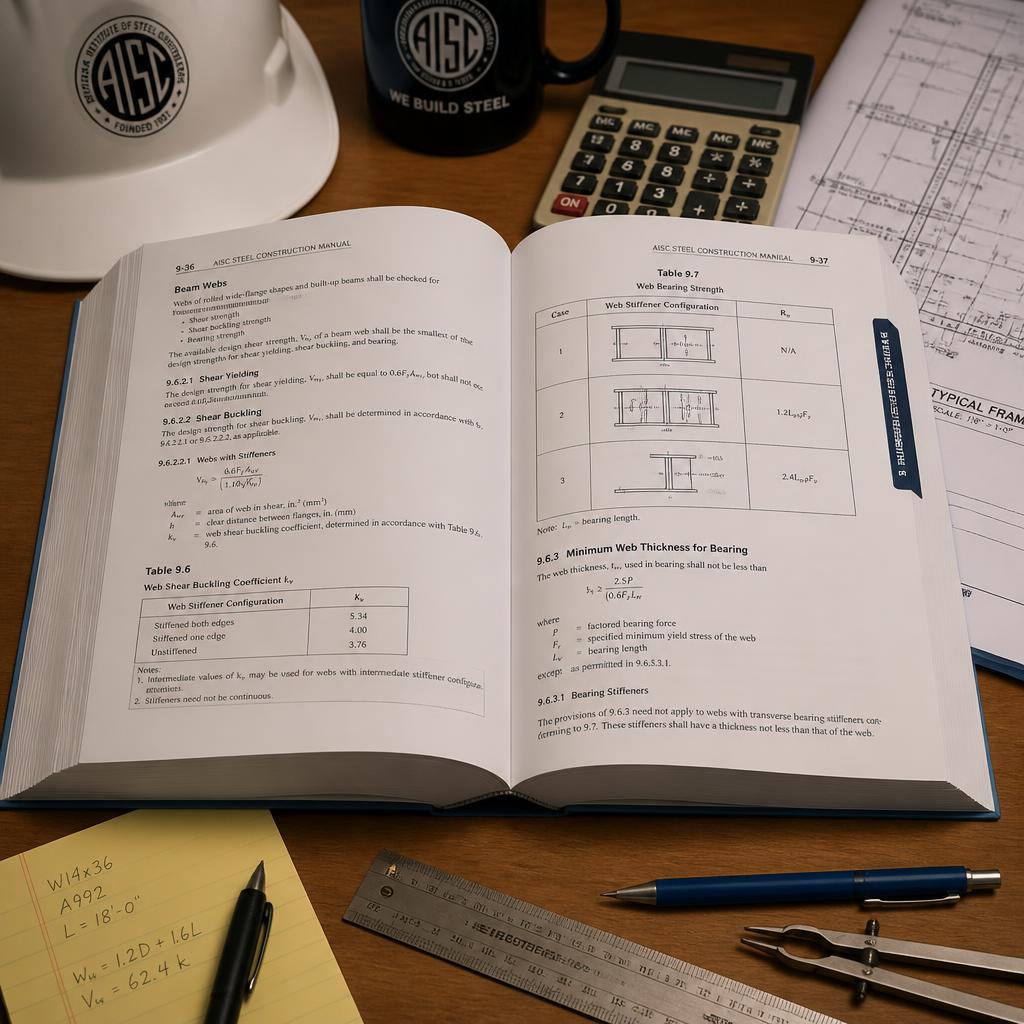
State the roles of AISC 360-22, AISC Manual (16th ed.), ASCE 7, and IBC in a design.
Why it matters
Signed structural drawings must cite the governing code. A missing or wrong citation is grounds for plan-check rejection and, in litigation, professional liability.
Where it is used
Every cover sheet, calculation package, and peer review references these four documents.
Connects to
Chapter 2 (LRFD load combinations) is entirely a reading of ASCE 7 §2 and AISC 360 §B.
Objective 05
Contrast LRFD vs ASD
Apply φRₙ ≥ Ru and know when ASD is still preferred.
Why it matters
LRFD and ASD both appear in AISC 360, but they demand different load combinations, resistance formulas, and reliability targets. Mixing them silently is a serious professional error.
Where it is used
New construction defaults to LRFD; some retrofits, wood-composite work, and legacy calculations use ASD.
Connects to
Every remaining chapter uses the LRFD form φRₙ ≥ Ru as its master equation.
Objective 06
Prepare for the FE exam
Speak fluently about loads, limit states, and safety factors on FE-style problems.
Why it matters
The FE Civil / Structural exam draws 8–12% of its questions from concepts introduced in this single chapter. Fluency here compounds across the exam.
Where it is used
FE and PE examinations, employer entry interviews, and the vocabulary of every design meeting you will ever attend.
Connects to
The FE Exam Preparation panel at the end of this chapter tests this objective directly.
03
Engineering motivation
What each part of a steel-frame building actually does — and why it exists
Before you design any single member, you have to see the whole system. A steel-frame building is not a collection of independent shapes bolted together — it is a deliberate load path, engineered so that every kilonewton of gravity, wind, or seismic demand has a continuous route from where it starts to the ground where the earth can resist it.
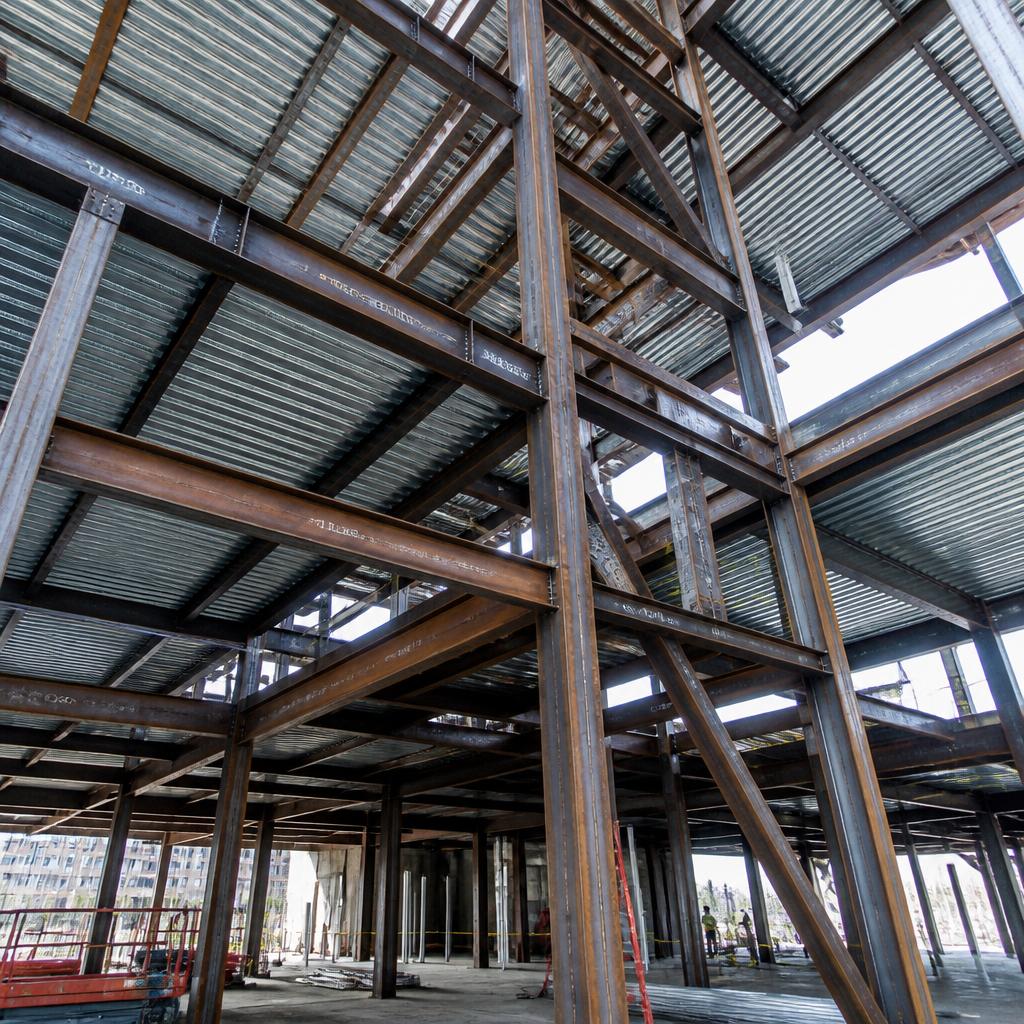
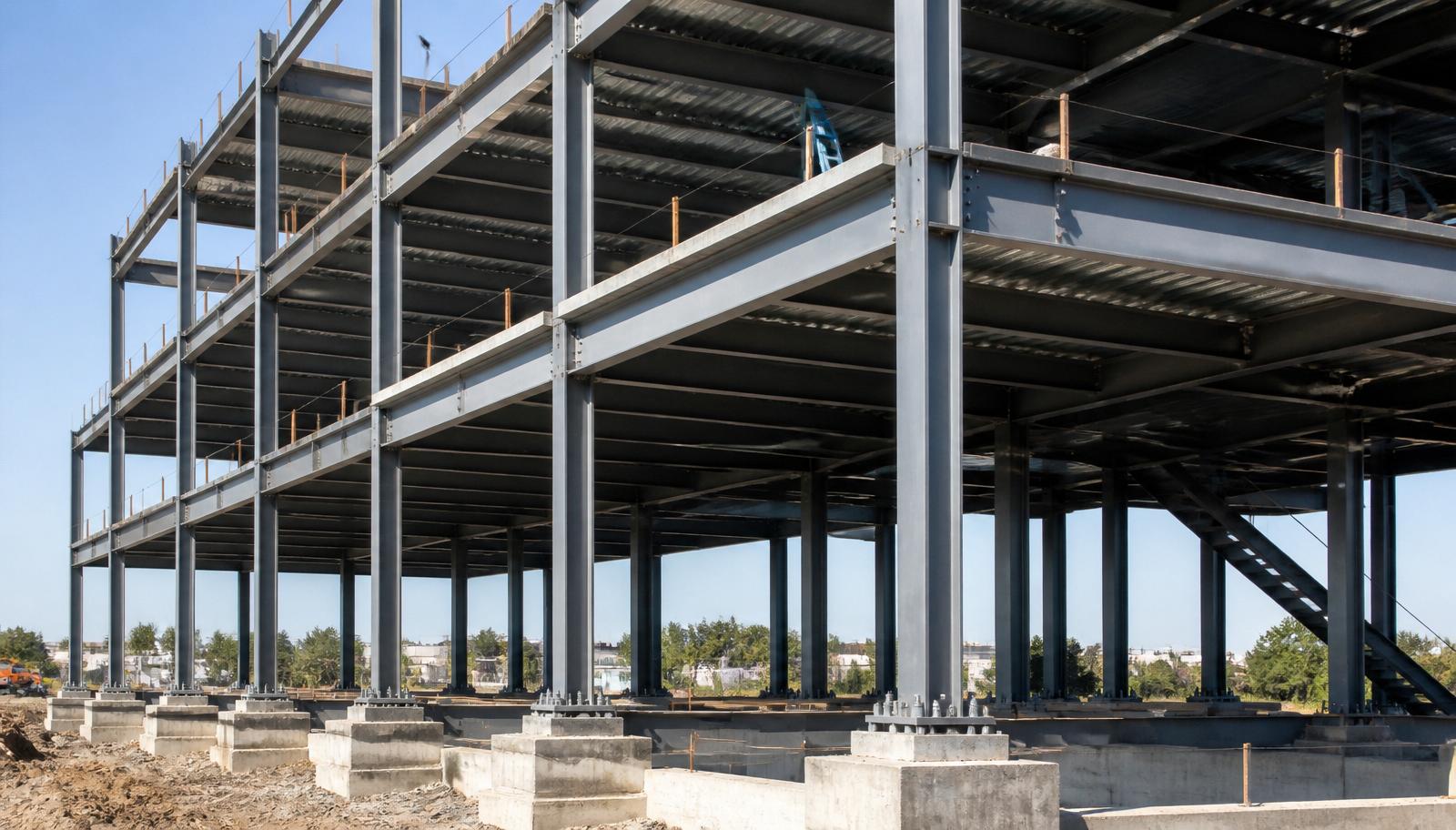
The photograph below shows a typical steel framing detail. Drag each labelled chip onto the structural element it names — the drop is only accepted when it lands inside the correct element's outlined region. A correct answer locks in with a green outline and a short explanation; a wrong answer flashes the region red, tells you what you actually hit, and returns the chip so you can try again. Press Reveal expected placements to see the reference solution (that attempt is then marked as assisted).
Fig. 1.3 · Drop a chip inside the outlined element it names. Green = correct and locked; red flash = wrong element, chip returns.
04
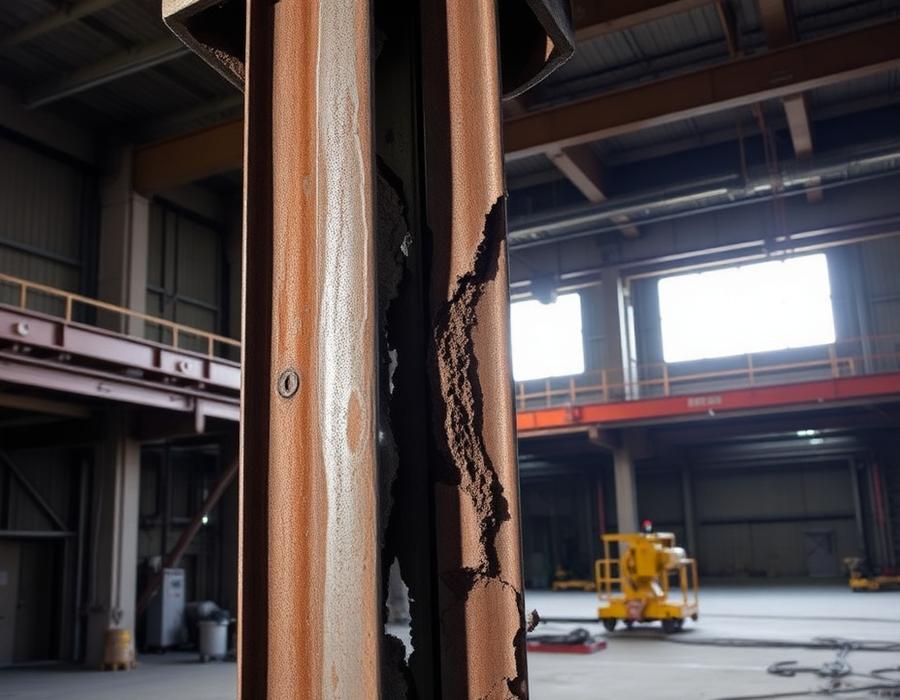
Failure mechanisms
Why we design the way we do — six ways steel structures have failed, and what each disaster taught the profession
Every provision in AISC 360 is a scar. Behind each equation, load factor, and detailing rule is a bridge, a walkway, or a tower whose failure cost lives and rewrote the profession. The six case studies below trace the mechanisms that motivate the code you are about to learn.
Read each one as an engineer, not a spectator: identify the load, the limit state, the missing check, and the specific clause that exists today because that check was missed. When you meet those clauses again in Chapters 5–17, they will read as answers, not rules.
Case 01
1907
Fig. 1.4.1 · Quebec Bridge, 1907 — the south cantilever arm collapsed during erection because the lower chords were dangerously slender. 75 workers died.
Failure mechanism
Column buckling
Slender compression members can suddenly deflect sideways under axial load, losing their capacity to carry vertical force well before the material reaches its yield stress.
Root cause
The critical (Euler) stress F_e = π²E/(KL/r)² drops with the square of slenderness. Once F_e falls below F_y, geometric instability, not yielding, governs — and the deflection is sudden.
Historical case
Quebec Bridge, 1907 — the south cantilever arm collapsed during erection because the lower chords were dangerously slender. 75 workers died.
Lesson learned
Every column must be checked with the effective-length method (or direct analysis). Provide bracing so KL/r stays comfortably inside limits and confirm F_cr governs, not F_e.
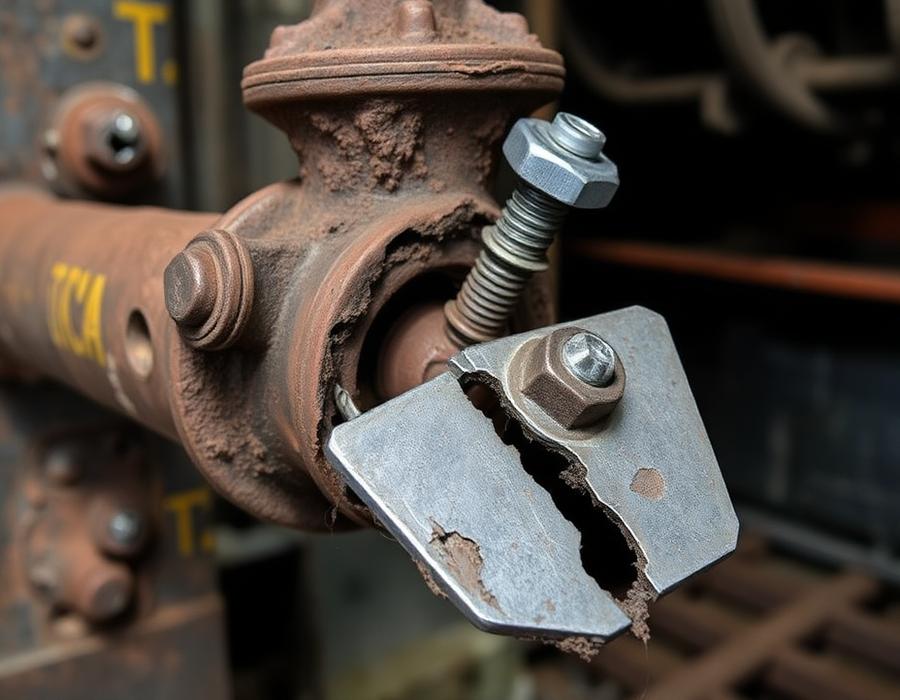
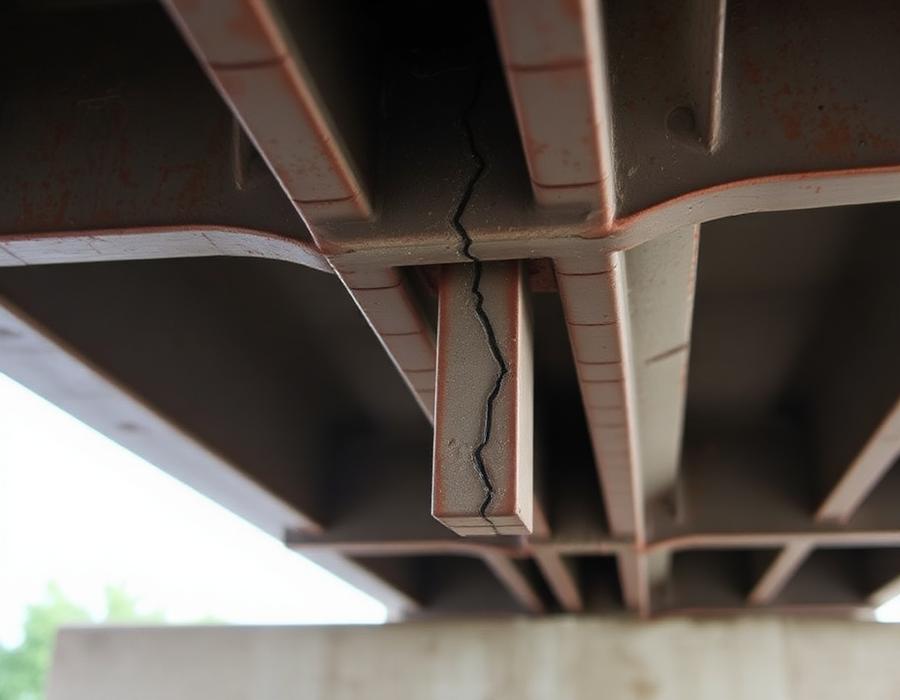
Fig. 1.4.2 · Hyatt Regency walkway, Kansas City, 1981 — a doubled hanger-rod detail overloaded a single nut, killing 114 people. The bolted joint carried twice the design load.
Failure mechanism
Connection fracture
Bolts, welds, or the plates they join can fail before the members they connect — a brittle, near-instant failure mode with no warning ductility.
Root cause
Connections concentrate stress. When a joint is designed for the applied load rather than the member capacity, an unexpected overload finds the joint first.
Historical case
Hyatt Regency walkway, Kansas City, 1981 — a doubled hanger-rod detail overloaded a single nut, killing 114 people. The bolted joint carried twice the design load.
Lesson learned
Design connections for the full expected demand plus a robustness margin; check bolt shear, bearing, block shear, and weld-metal capacity. Detail every joint on the drawings.
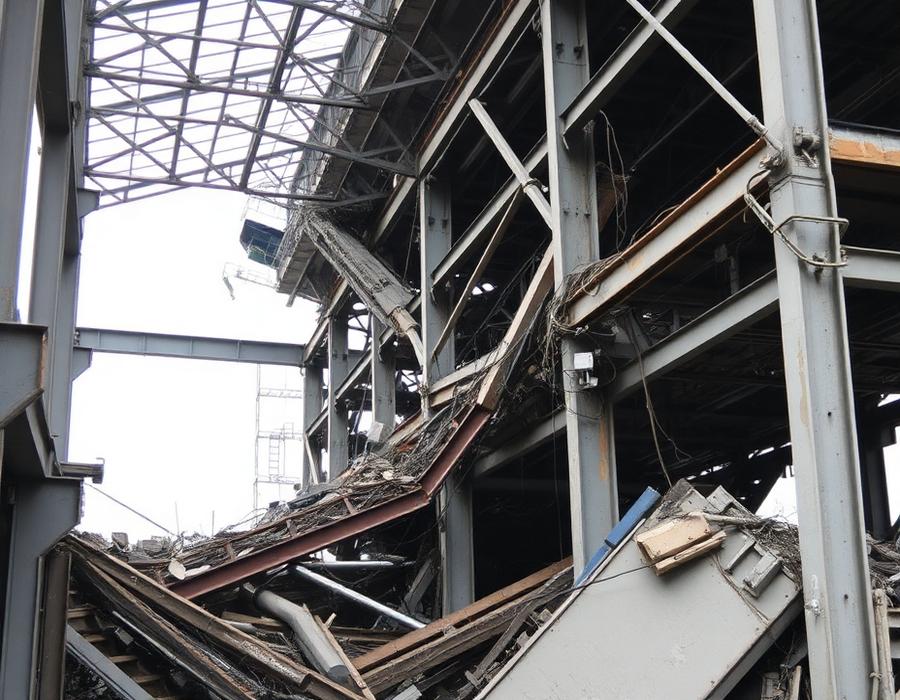
Fig. 1.4.3 · Ronan Point apartment tower, London, 1968 — a gas explosion knocked out a single load-bearing panel; four floors of the 22-storey tower peeled away.
Failure mechanism
Progressive collapse
A single member or connection fails, adjacent members overload beyond their reserve, and the collapse propagates through the structure like falling dominos.
Root cause
Structures with no alternate load path cannot redistribute demand when one element is lost. Disproportionate damage results from a localized cause.
Historical case
Ronan Point apartment tower, London, 1968 — a gas explosion knocked out a single load-bearing panel; four floors of the 22-storey tower peeled away.
Lesson learned
Provide continuous ties and alternate load paths. Design for local resistance to key-element removal per ASCE 7 and IBC robustness provisions.
Fig. 1.4.4 · Countless office-fit-out disputes and long-span library-floor complaints — expensive to remediate, rarely front-page news, always avoidable.
Failure mechanism
Excessive deflection
Members satisfy strength requirements but sag so much that finishes crack, doors bind, glazing pops, and equipment misaligns — a serviceability failure, not a strength failure.
Root cause
Strength design targets ultimate capacity, not stiffness. A section that satisfies M_u ≤ φM_n can still deflect far beyond what non-structural elements tolerate.
Historical case
Countless office-fit-out disputes and long-span library-floor complaints — expensive to remediate, rarely front-page news, always avoidable.
Lesson learned
Check L/360 (live), L/240 (total), and floor-vibration criteria alongside strength. Serviceability is a design check, not an afterthought.
Fig. 1.4.5 · I-35W bridge, Minneapolis, 2007 — an undersized gusset plate combined with decades of cyclic truck loading initiated the collapse that killed 13 people.
Failure mechanism
Fatigue cracking
Cyclic loads propagate a microscopic crack through welds and net sections until the member separates — often at stress ranges well below the yield strength.
Root cause
Every stress cycle grows an existing flaw a tiny amount. After millions of cycles the crack reaches the critical size and the remaining section fractures suddenly.
Historical case
I-35W bridge, Minneapolis, 2007 — an undersized gusset plate combined with decades of cyclic truck loading initiated the collapse that killed 13 people.
Lesson learned
For cyclically loaded members, apply the AISC fatigue provisions: identify the detail category, compute the stress range, and stay below the allowable.
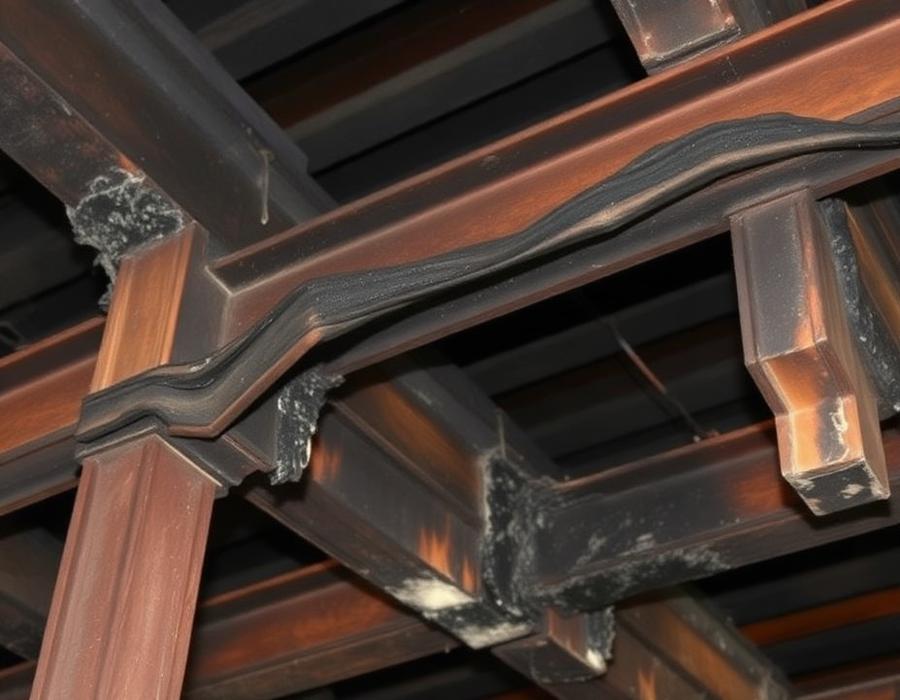
Fig. 1.4.6 · World Trade Center towers, 2001 — sustained aviation-fuel fires compromised fireproofing and column stiffness, contributing to progressive collapse.
Failure mechanism
Fire damage
Above roughly 550 °C bare structural steel loses about half its yield strength and roughly a third of its stiffness — it can deform plastically under normal service loads.
Root cause
Steel is non-combustible but not fire-resistant. Its material properties degrade rapidly with temperature; unprotected sections reach critical temperature in ~10–20 minutes of standard fire exposure.
Historical case
World Trade Center towers, 2001 — sustained aviation-fuel fires compromised fireproofing and column stiffness, contributing to progressive collapse.
Lesson learned
Provide passive fire protection (spray, board, or intumescent coating) sized for the required rating; verify with AISC Appendix 4 or performance-based design.
§IBC Chapter 7 · AISC 360-22 Appendix 4 (Structural Design for Fire Conditions)
How failure propagates
The five-stage failure progression
1Load
2Yield
3Instability
4Failure
5Collapse
Design codes intervene at the transition from yield to instability. Everything before yield is elastic and reversible; everything after instability is a race to collapse. LRFD keeps the demand well below the first transition.
05
Lecture notes
The full textbook chapter — figures, equations, and engineering narrative
Reflection · Think before you read
Look around any building you've been in this week. Which members are in tension, compression, or bending — and how would the structure fail if the weakest of those members disappeared?
Lecture Notes: Chapter 1 — Fundamental Concepts of Structural Design
Chapter focus. Before any equation, you need vocabulary: what a "structure" is, what a "load" is, and what could go wrong. This chapter opens with real failures (Hyatt Regency, FIU pedestrian bridge) to motivate why we design for redundancy and ductile limit states, then defines the five load types (D, L, W, S, E) and the two design philosophies you'll spend the rest of the course choosing between — LRFD and ASD.
1. Introduction to Structures & The Design Process
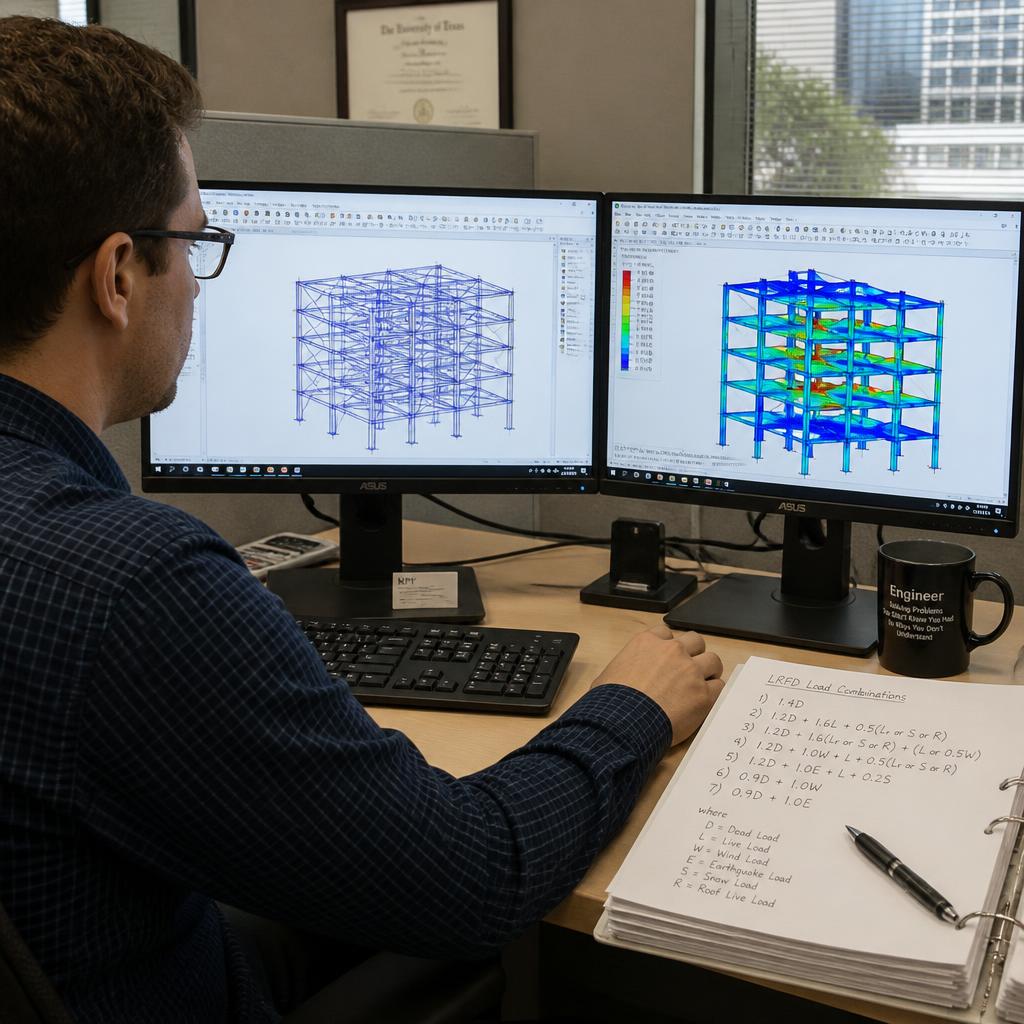
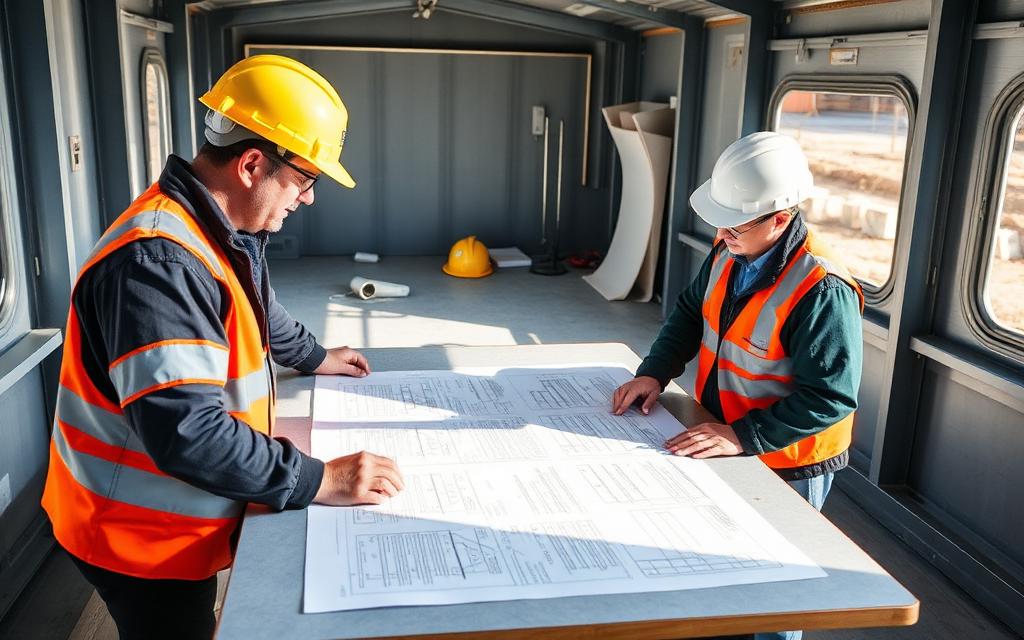
Structural Engineer On-Site — Coordinating Analysis, Design, and Construction
A STRUCTURE is a system of connected components designed to support applied forces while executing its primary architectural or engineering function. This course focuses strictly on civil structures (e.g., commercial buildings, bridges, communication towers) rather than military or mechanical variants (e.g., naval hulls, aircraft bulkheads, or tanks).
Structural engineering balances both technical analysis and design innovation. Every project is executed with strict adherence to five baseline criteria:
Safety: Preventing structural collapse under extreme loading distributions.
Serviceability: Eliminating disruptive real-world behaviors (e.g., excessive vibrations or deflections) during routine operation.
Aesthetics: Harmonizing visually with local surroundings and architectural goals.
Economy: Minimizing structural material cost, manufacturing labor, and lifecycle expenses.
Environmental Conditions: Resisting specialized regional factors like seismic acceleration, wind shear currents, or snow loads.
The Structural Engineering Workflow Loop
Establish structural configuration and geometric layout options.
Perform structural frame analysis to resolve internal element design actions (bending moments, axial forces, shear).
Size physical elements and engineer safe connection detailing matching limit-state rules.
Evaluate structural alternatives and execute design optimization loops.
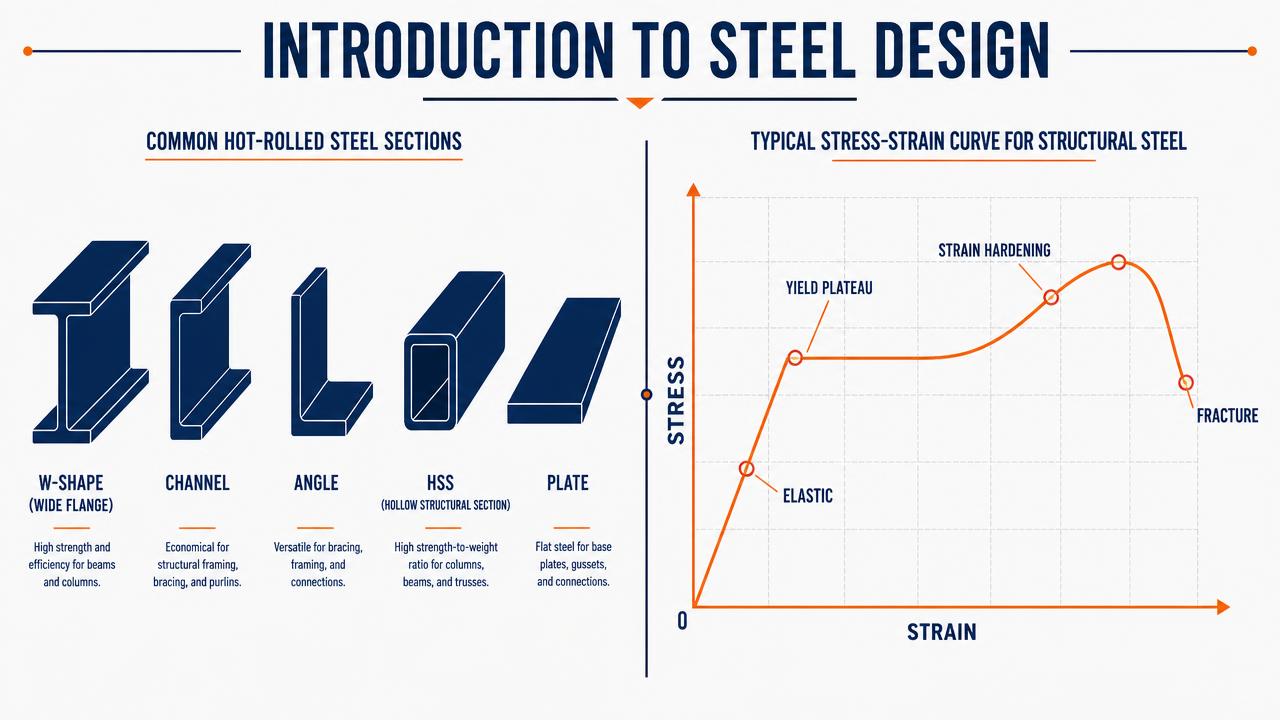
1A. Introduction to Steel Design — the material behind every equation
Hot-rolled shape families and the stress–strain response that every AISC limit state is built on
Structural steel is an alloy of iron with a carefully controlled carbon content (roughly 0.15–0.30% for structural grades) plus small additions of manganese, silicon, vanadium and copper. It is produced in an electric-arc furnace from recycled scrap — typically over 90% recycled content — then continuously cast and hot-rolled through a sequence of stands until it takes the final profile. Everything you will design in this course starts as one of those rolled profiles, a plate cut from a coil, or a bolt/weld joining them.
Why engineers choose steel
High strength-to-weight ratio. A992 steel yields at Fy = 50 ksi while weighing 490 pcf, so long spans and tall frames can be built with a fraction of the self-weight of concrete. Lower self-weight means smaller columns and smaller foundations.
Ductility. Structural steel strains 15–25% before fracture. That reserve is what allows plastic redistribution, gives visible warning before collapse, and makes seismic design possible.
Predictability. Steel is manufactured under mill certification, so its properties are far tighter than site-poured materials. This is precisely why its resistance factor φ is high (0.90 for yielding).
Speed of erection. Members are fabricated off-site and bolted in the field; a floor can be framed in days rather than the weeks a cast-in-place structure needs to cure.
Adaptability and reuse. Bolted frames can be reinforced, re-framed or dismantled, and the steel is fully recyclable at end of life.
And where steel needs care
Corrosion. Unprotected steel rusts; exposed and marine structures need galvanizing, paint systems or weathering grades, plus a maintenance budget.
Fire. Steel loses roughly half its yield strength near 1100 °F, so fireproofing (spray-applied, intumescent or encasement) is mandatory in buildings.
Buckling. Because sections are thin and efficient, stability — not material strength — usually governs compression members and unbraced beams. Chapters 5, 6 and 8 are entirely about this.
Fatigue and brittle fracture. Repeated stress cycles at welded details, and low temperatures at thick sections, both limit capacity (AISC 360-22 Appendix 3).
Reading the stress–strain curve
Every design equation in AISC 360-22 traces back to the tension-coupon curve on the right of the figure above:
Elastic range. Stress is proportional to strain, σ = Eε, with E = 29,000 ksi for all structural steels. Deflection, buckling and drift checks live here.
Yield plateau. At Fy the section strains at essentially constant stress. Plastic-moment capacity Mp = ZxFy assumes the whole section reaches this plateau.
Strain hardening. Stress climbs again toward the tensile strength Fu. Rupture limit states (net section, bolt bearing, welds) are written against Fu, not Fy.
Necking and fracture. The specimen localizes and breaks. Because this is a brittle end state, rupture checks carry the lower φ = 0.75.
The grades you will specify
Grade
Typical use
Fy (ksi)
Fu (ksi)
ASTM A992
W-shapes — beams and columns (the default)
50
65
ASTM A572 Gr. 50
Plates, gussets, base plates, built-up shapes
50
65
ASTM A36
Angles, small plates, miscellaneous steel
36
58
ASTM A500 Gr. C
Rectangular and round HSS — braces, columns
50 (round 46)
62
ASTM F3125 Gr. A325 / A490
High-strength bolts
—
120 / 150
Design habit to build now. Before any calculation, write down the shape, the grade, Fy and Fu. Half of all student errors in this course come from applying an Fy equation to a rupture limit state, or using 36 ksi on an A992 W-shape.
2. Four Basic Structural Types
A structural SYSTEM is composed of individual structural MEMBERS joined by structural CONNECTIONS. Modern industrial layouts integrate variations of these four primary frameworks.
A. Trusses
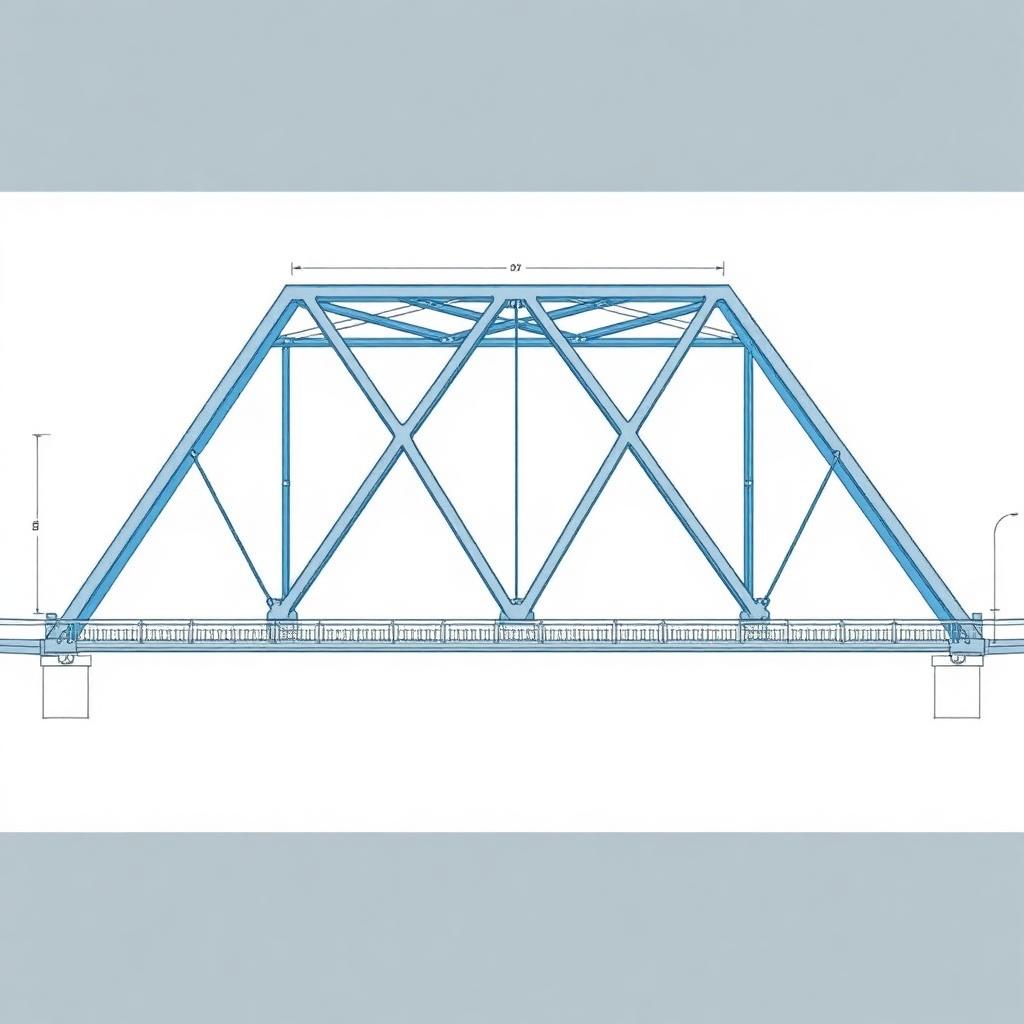
Formed by arranging slender elements in triangular geometries. Because members are assumed to be pin-connected at joints, they develop primarily axial tension or compression forces without localized bending moments. Classified as planar trusses (roof trusses, traditional bridges) or space trusses (transmission towers).
Pratt Truss — Axial-Only Members
B. Cables & Arches
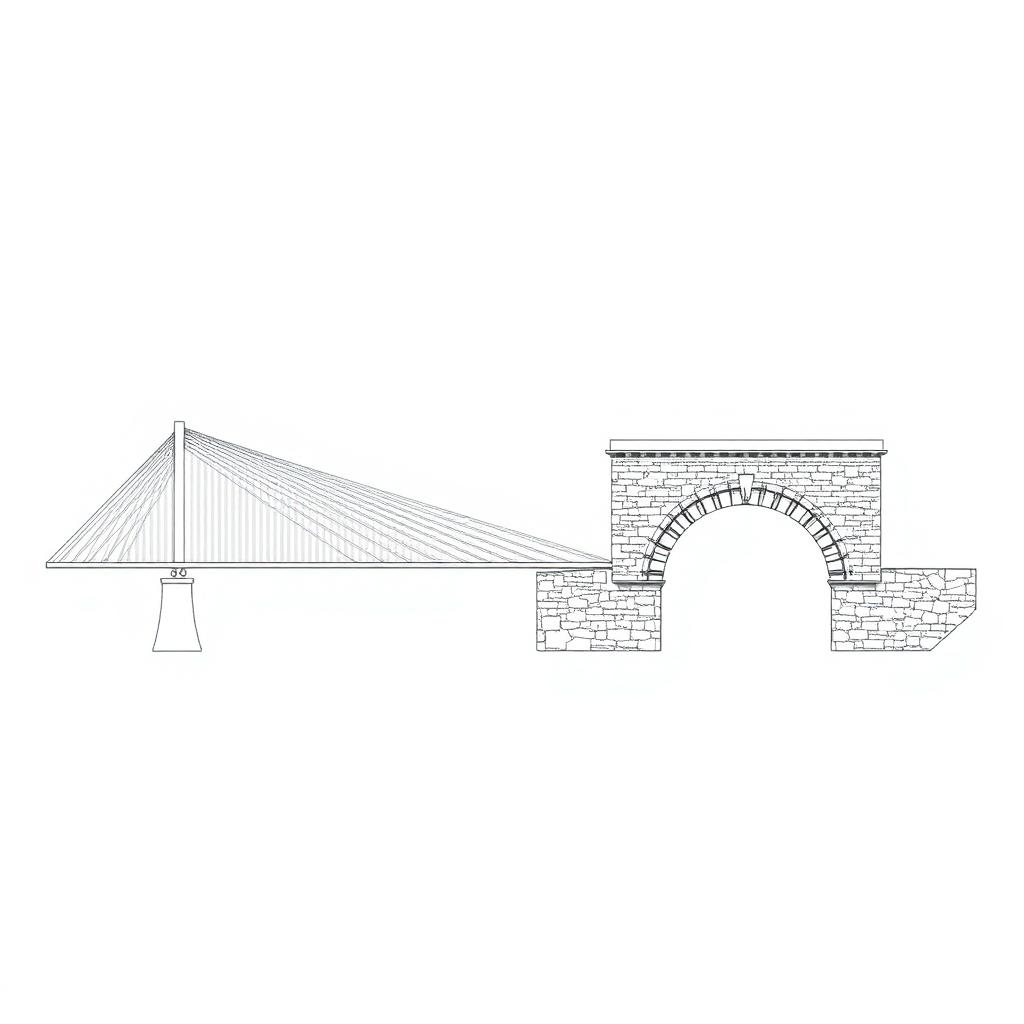
Optimized systems targeting specific internal force profiles for long-span bridges or overhead sports-dome roofs. Flexible cables carry load entirely in tension (relying on geometric sag), whereas rigid arches support forces primarily in compression.
Cable (Tension) vs Arch (Compression)
C. Frames
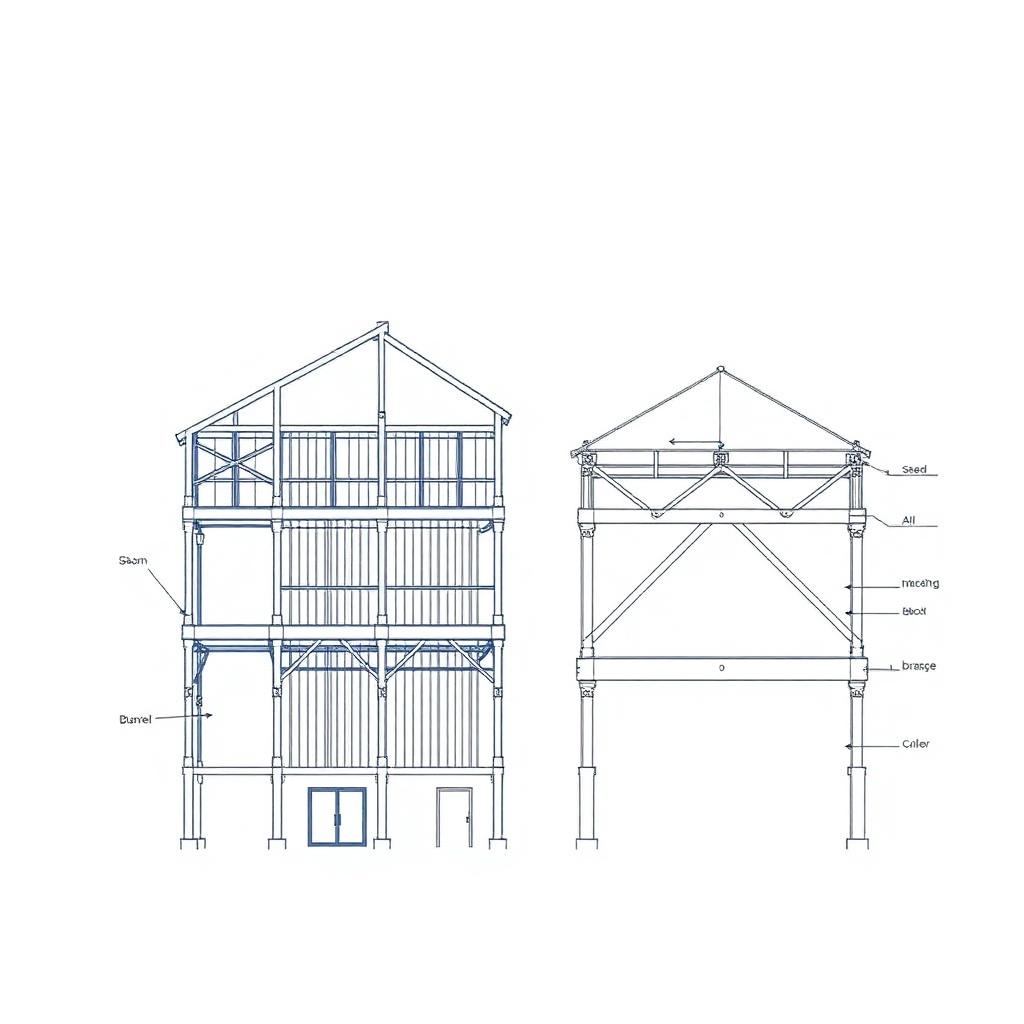
Composed of interlocking beams and columns. Standard configurations divide into braced frames (which integrate diagonal pin-connected steel angles to handle side-sway forces) and rigid moment frames (which incorporate continuous, stiff monolithic joints to resist moment rotations without bracing elements).
Moment Frame vs Braced Frame
D. Surface Structures
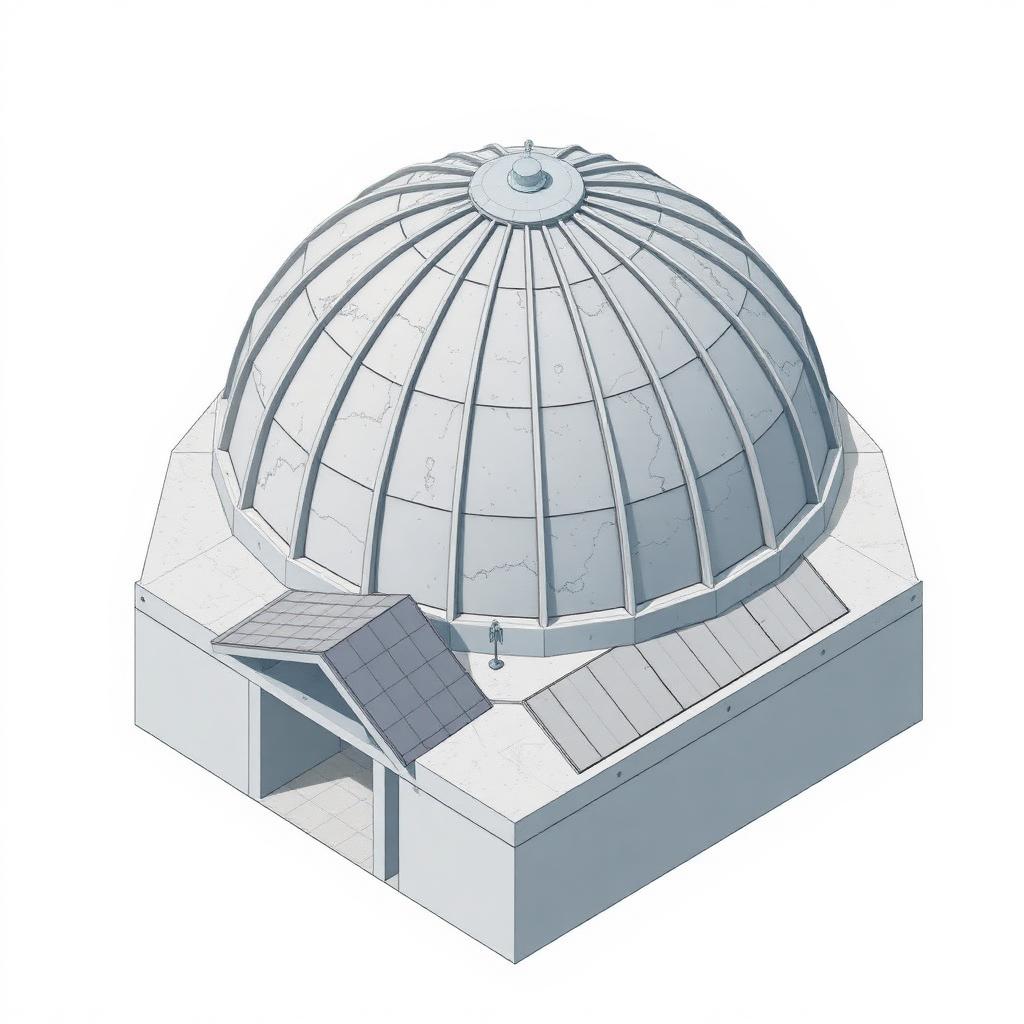
Composed of thin, curved or folded continuous elements (membranes, thin plates, or concrete shells). Forces resolve into highly efficient in-plane tensile or compressive fields rather than heavy bending moments. Examples include concrete domes, aircraft hangars, and folded-plate roofs.
Shell Dome & Folded Plate
3. Structural Members
Individual members are classified by the dominant internal force they resist:
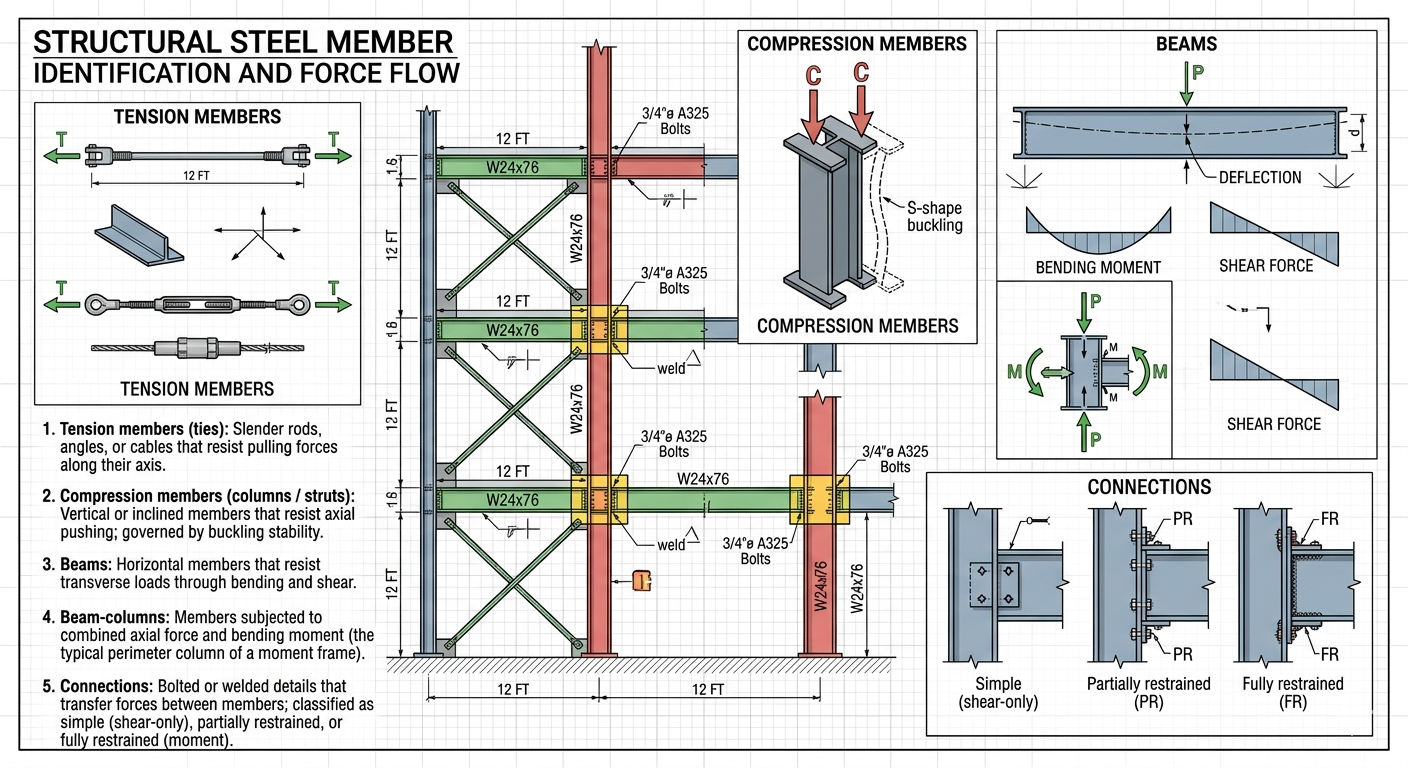
Tension members (ties): Slender rods, angles, or cables that resist pulling forces along their axis.
Compression members (columns / struts): Vertical or inclined members that resist axial pushing; governed by buckling stability.
Beams: Horizontal members that resist transverse loads through bending and shear.
Beam-columns: Members subjected to combined axial force and bending moment (the typical perimeter column of a moment frame).
Connections: Bolted or welded details that transfer forces between members; classified as simple (shear-only), partially restrained, or fully restrained (moment).
Structural Steel Member Identification & Force Flow
4. Types of Loads (ASCE 7)
ASCE 7-22 Loads on a Typical Building Frame — Gravity (D, L, Lr, S) Down, Wind (W) Lateral, Seismic (E) Inertial Story Forces
Gravity Loads
Dead Load (D): Self-weight of permanent construction — slabs, beams, cladding, MEP.
Live Load (L): Movable occupancy loads — people, furniture, storage. Tabulated by occupancy in ASCE 7 Table 4.3-1.
Roof Live (Lr) & Snow (S): Maintenance access vs accumulated snow per regional ground-snow maps.
Rain (R): Ponding load when drainage is impaired.
Lateral & Environmental Loads
Wind (W): Velocity pressure converted to surface pressure using exposure, topography, and gust factors (ASCE 7 Ch. 26–30).
Seismic (E): Inertial forces from ground acceleration; determined by site class, SDS / SD1, and a response-modification factor R (ASCE 7 Ch. 12).
Thermal, settlement, and impact loads: Special-case actions handled per ASCE 7 §2.3.
⚠ Critical Reminder
Never design a member for a single load case in isolation. The governing demand always comes from an LRFD load combination (e.g., 1.2D + 1.6L, 1.2D + 1.0W + L + 0.5Lr) — covered in Chapter 2.
5. Looking Ahead
The remainder of this course applies these foundations to steel design: load combinations and LRFD (Ch. 2), material behavior (Ch. 3), tension members (Ch. 4), compression and beams (Ch. 5–6), connections (Ch. 7–9), and a capstone building design.
6. Regulatory Codes & Design Frameworks
To ensure structural performance and protect public safety, building design in the United States follows specialized codified standards:
Structural Steel: Governed by AISC 360-22 (Specification for Structural Steel Buildings) and detailed in the 16th Edition of the AISC Steel Construction Manual (split into 18 primary parts).
Reinforced Concrete: Controlled by ACI 318-19 (Building Code Requirements for Structural Concrete).
Design Loading: Derived from ASCE 7 (Minimum Design Loads and Associated Criteria for Buildings and Other Structures), establishing regulatory live, dead, seismic, wind, and environmental limits.
AISC 360-22 — Structural Steel
ACI 318-19 — Structural Concrete
ASCE 7 — Design Loads
7. LRFD vs. ASD: Design Philosophy & Numerical Metrics
The AISC code provides structural engineers two distinct methods side-by-side. Both target structural safety but distribute safety factors differently:
Load and Resistance Factor Design (LRFD)
φ · Rn ≥ Σ γi · Qi
A modern limit-states standard. It accounts for load variation by scaling service demands up using overload factors (γi > 1.0) and scales nominal capacities down using a resistance factor (φ < 1.0) based on material limit states.
Allowable Strength Design (ASD)
RnΩ
≥ Ra
A classical elastic design baseline. Unfactored service working loads (Ra) are combined directly. Overall structural margin is maintained by dividing raw nominal resistance capacity by a global factor of safety (Ω > 1.0).
Feature / Parameter
LRFD Approach
ASD Approach
Analysis Basis
Plastic limit strength mechanics
Linear elastic stress restrictions
Safety Factor Distribution
Split parameters (γ for loads, φ for material)
Single global parameter (Ω factor of safety)
Output Verification Metric
Ultimate force capacity profiles
Allowable operational design stresses
Deflection Evaluation Checks
Identical service load combos (e.g., 1.0D + 1.0L). Deflection is a serviceability check, not a strength limit!
Structural engineering failure analysis reinforces that connection design and peer review are as critical to public safety as member sizing. Two major structural connection failures underscore this reality:
Hyatt Regency Walkway Collapse (Kansas City — July 17, 1981): 114 fatalities and over 200 injuries. The disaster stemmed from a field modification that doubled the load on a critical hanger rod connection. The revised setup transferred load through a support beam box girder flange that lacked the capacity to support it, leading to a progressive punching shear failure.
FIU Pedestrian Bridge Collapse (Miami — 2018): Critical design errors in a concrete truss connection region, coupled with insufficient peer review and a failure to halt construction when severe structural cracking appeared.
Core Lesson
Structural connections transfer forces through complex load paths. Every connection detail must undergo thorough calculation, independent verification, and rigorous peer review before field implementation.
06
Professional practice, safety & ethics
Structural steel practice
Professional practice
•Know the difference between the AISC Specification (legally adoptable, referenced by the IBC) and the Manual (design aids). Only the Specification is code.
•Sealed drawings: the Engineer of Record (EOR) is responsible for the design basis; the fabricator's delegated engineer seals connection design when so noted.
•Document the design basis (loads, code year, material grades) on S-001 — undocumented assumptions are the leading source of RFIs.
Safety in design & construction
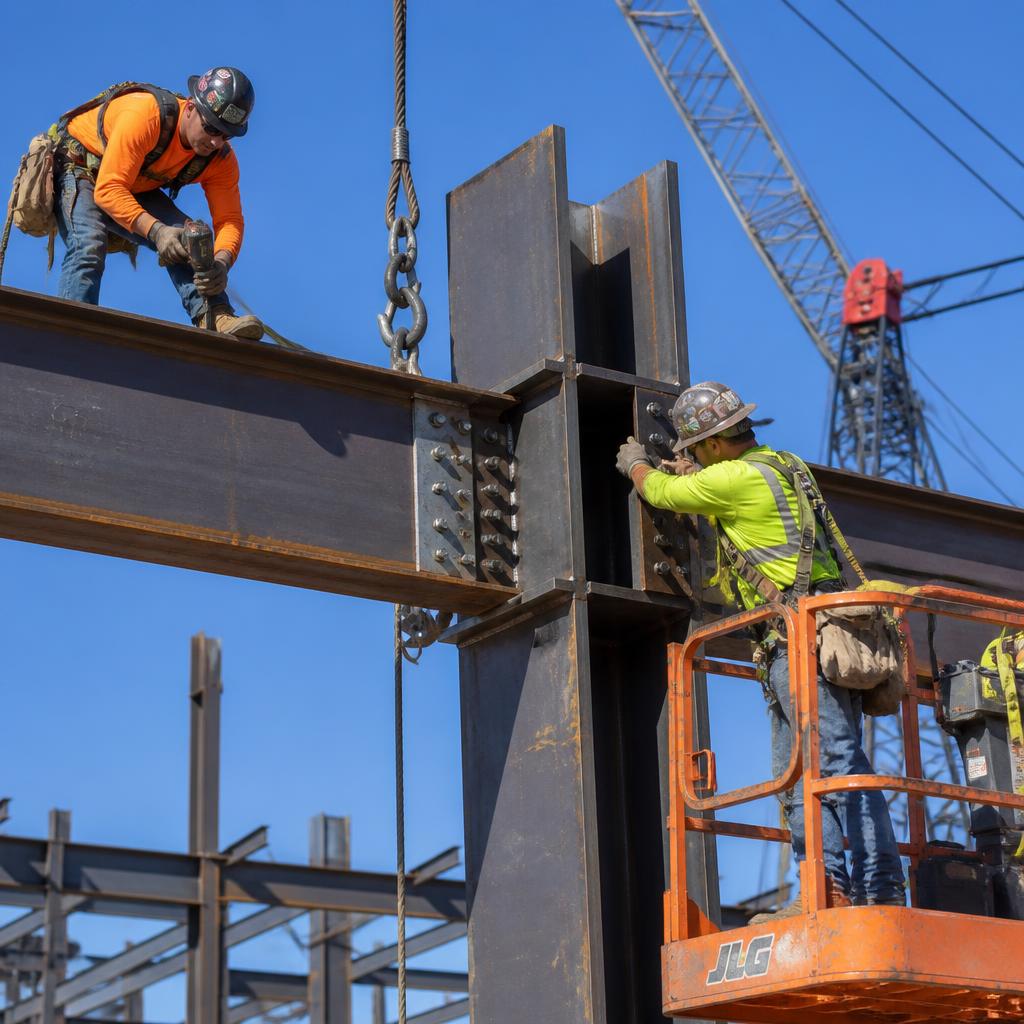
•Steel erection is governed by OSHA 29 CFR 1926 Subpart R: no member is released from the crane until at least two bolts per connection are in place.
•Erection stability is a construction-phase load case — the completed-structure bracing may not exist yet.
•Require a written erection sequence and temporary bracing plan before the first pick.
Engineering ethics
•NSPE Code I.1 — hold paramount public safety. A schedule or budget pressure is never a valid reason to skip a limit-state check.
•Practice only in your area of competence (NSPE II.2); steel connection design is a distinct competency from member design.
•Never seal drawings you did not prepare or supervise directly.
Erection safety: OSHA Subpart R fall protection and stable temporary bracing.Peer review and the engineer's seal: responsible charge and standard of care.
ABET / licensure link. These points map to ABET Student Outcomes 2 and 4 — engineering design within realistic constraints, and recognition of ethical and professional responsibilities. Expect NCEES FE and PE exam questions on the NSPE Code of Ethics, OSHA construction requirements, and the engineer's standard of care.
07
Cost analysis
Cost drivers in a steel building
Approach
•Steel is bought by weight ($/ton) but paid for by piece: fabrication and erection labor typically exceed the mill price of the material.
•Benchmark with an installed unit cost ($/lb or $/ft² of floor) early in schematic design, then refine with a takeoff.
•Fewer, heavier pieces usually beat more, lighter pieces — minimum weight is not minimum cost.
Worked cost example — Installed cost of a 2,400 lb W-shape beam
Basis: Material + shop + field, RSMeans-style unit rates
Line item
Qty
Rate
Cost
Mill material, W-shape
1.2 ton
$1,150
$1,380
Shop fabrication & painting
1.2 ton
$900
$1,080
Erection labor & crane
1.2 ton
$650
$780
Connections (2 shear tabs, bolts)
2 ea
$140
$280
Estimated total
$3,520
Takeaway. Material is only ~40% of the installed cost — a 10% weight saving that adds two connections usually loses money.
Unit rates are representative US averages for teaching purposes. On a real project, price with current local rates (RSMeans, fabricator quotes, or contractor pricing) and state the estimate date.
08
Animated concepts
Key mechanics visualised — watch the strain profile, stress block, or buckled shape evolve
Load path — floor to foundation
Every force must follow a continuous path: slab → beam → girder → column → footing → soil. Interrupt this chain and the structure fails.
09
Engineering figures
Full-page reference diagrams — the visual vocabulary you will use for the rest of the course
§1.6.1
Steel production
Every W-shape, HSS, and plate in the AISC Manual passes through the same five-stage industrial process. Understanding it explains why some shapes exist and others do not.
Fig. 1.1Continuous casting and hot rolling
Red-hot billet passing through the finishing stands of a structural rolling mill — the last stage before a W-shape reaches the AISC Manual.
Engineering commentary
Rolling economics dictate the AISC shape family: sections that share a rolling geometry share a mill run, which is why W14 columns share flange widths across a wide range of weights.
§1.6.2
Common steel shapes
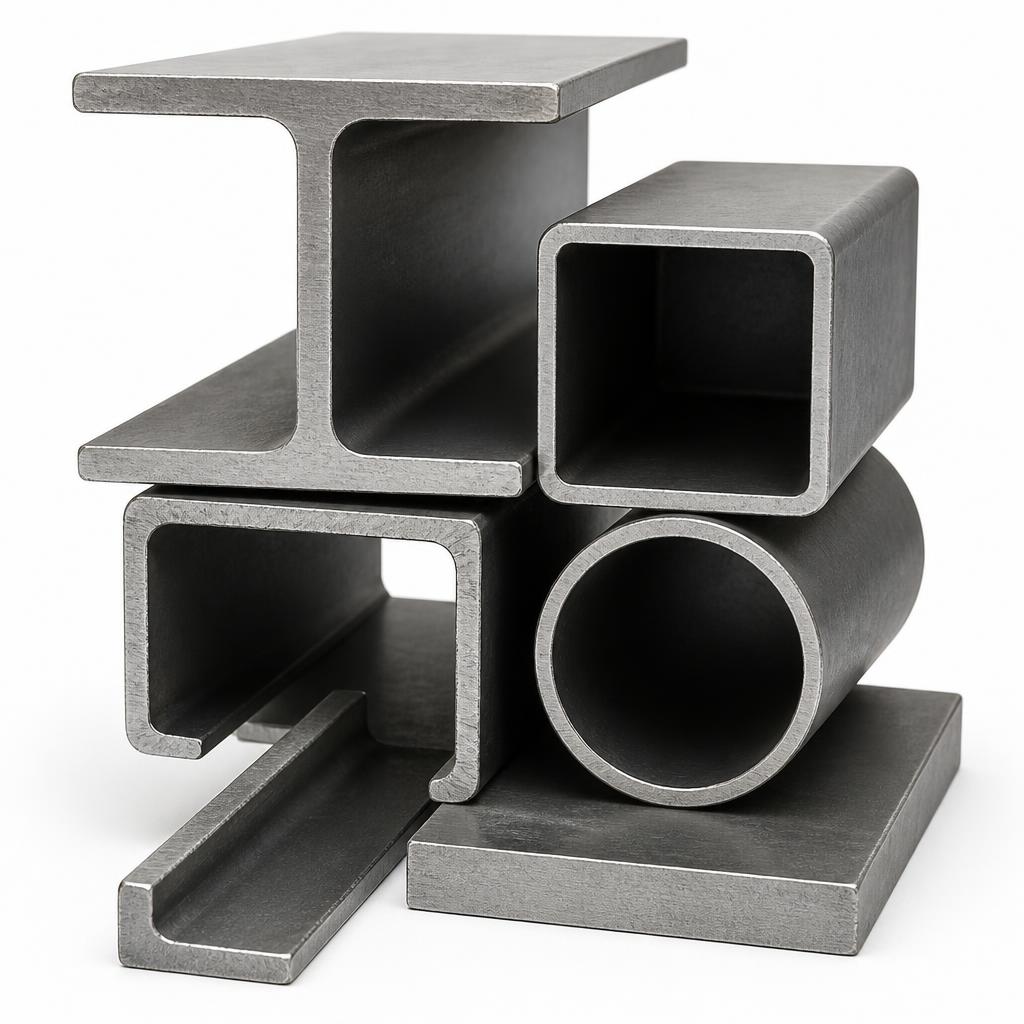
The AISC Manual catalogs roughly a dozen shape families. Six of them — W, HSS, C, L, Pipe, and Plate — do the vast majority of the work in real buildings.
Fig. 1.2W, HSS, C, L, Pipe, Plate — the working set
Real cross-sections of the six shape families that account for over 95% of AISC-listed steel members.
Engineering commentary
The shape you pick constrains everything downstream: torsion resistance (closed vs. open), connection detailing (flanges vs. HSS walls), and even fireproofing surface area.
§1.6.3
Structural systems
Four idealized systems — truss, moment frame, arch, and braced frame — account for the load path of nearly every steel building you will ever design.
Fig. 1.3Truss, moment frame, arch, braced frame
Four steel systems photographed in service: warehouse truss, multi-story moment frame under erection, tied-arch bridge, and diagonally braced facade.
Engineering commentary
The system controls the analysis model. Trusses are axial-only, moment frames are flexural, arches are compression-dominant, braced frames are hybrid. Choose the system first, then size the members.
§1.6.4
Connection types
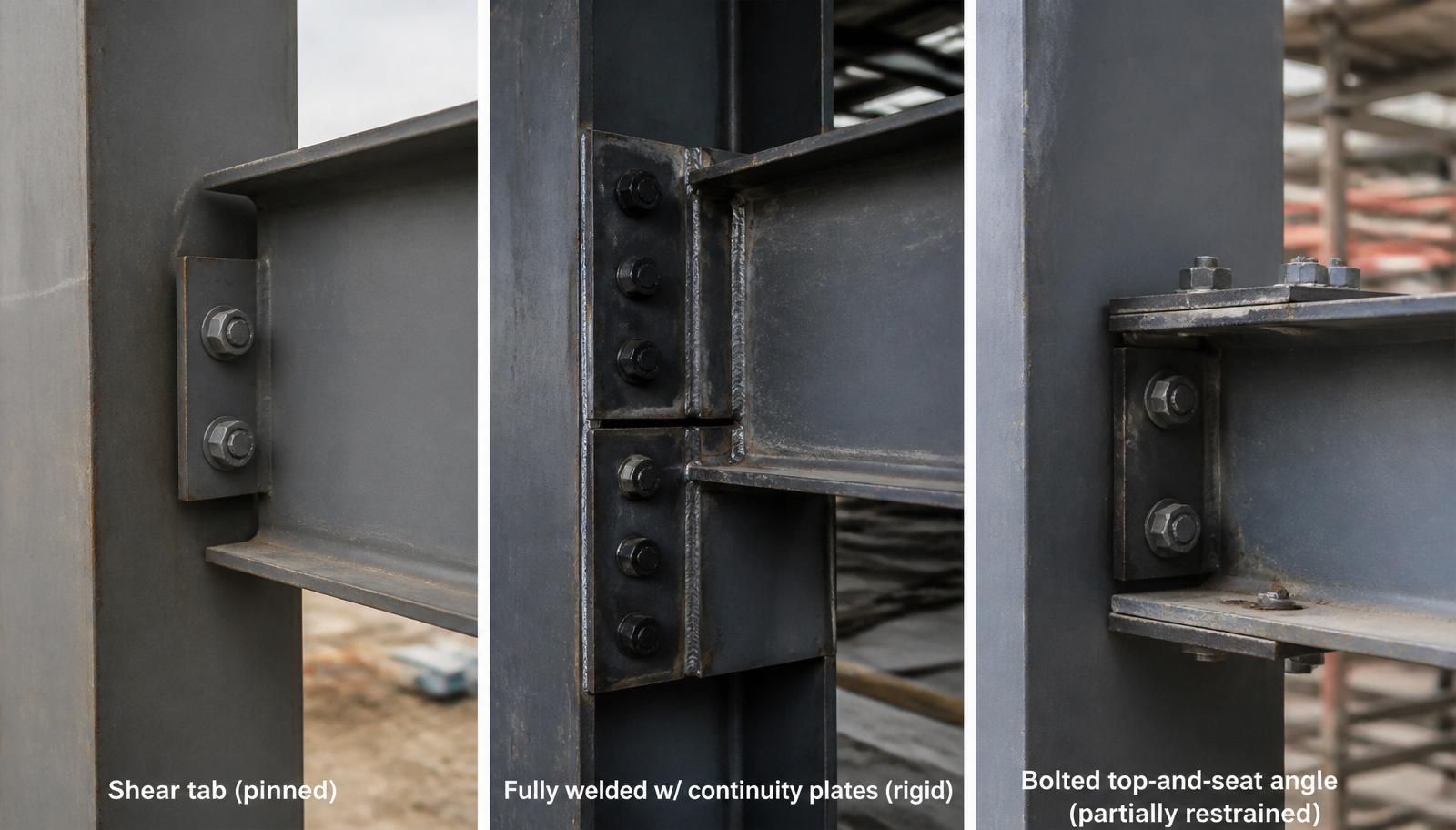
AISC 360 Chapter B lets you idealize joints as pinned, rigid, or partially restrained. The choice you make on the plan sheet cascades through the entire analysis.
Fig. 1.4Pinned, rigid, partially restrained
Left: a shear tab (pinned). Center: a fully welded flange connection with continuity plates (rigid). Right: a bolted top-and-seat angle (partially restrained). The idealization chosen on the drawing set controls the analysis.
Engineering commentary
A shear tab is pinned; a bolted flange plate is rigid; a top-and-seat angle is partially restrained. Detailing the wrong idealization is one of the fastest ways to invalidate a design.
§1.6.5
Vertical load path
The vertical load path is a five-step relay: roof or slab → beam → girder → column → foundation. Every gravity load in every steel building follows this sequence.
Steel-frame building mid-construction, showing the physical load path: concrete slab on metal deck, wide-flange floor beams supported by girders, framing into columns and column base plates on isolated concrete footings.
Engineering commentary
Draw this diagram on every framing plan you produce. When your reviewer cannot trace one continuous route from load to ground, your design is not finished.
10
Worked examples
Full textbook solutions — problem, theory, step-by-step, verification, interpretation
S1
Identify the controlling LRFD combo
FE Civil style
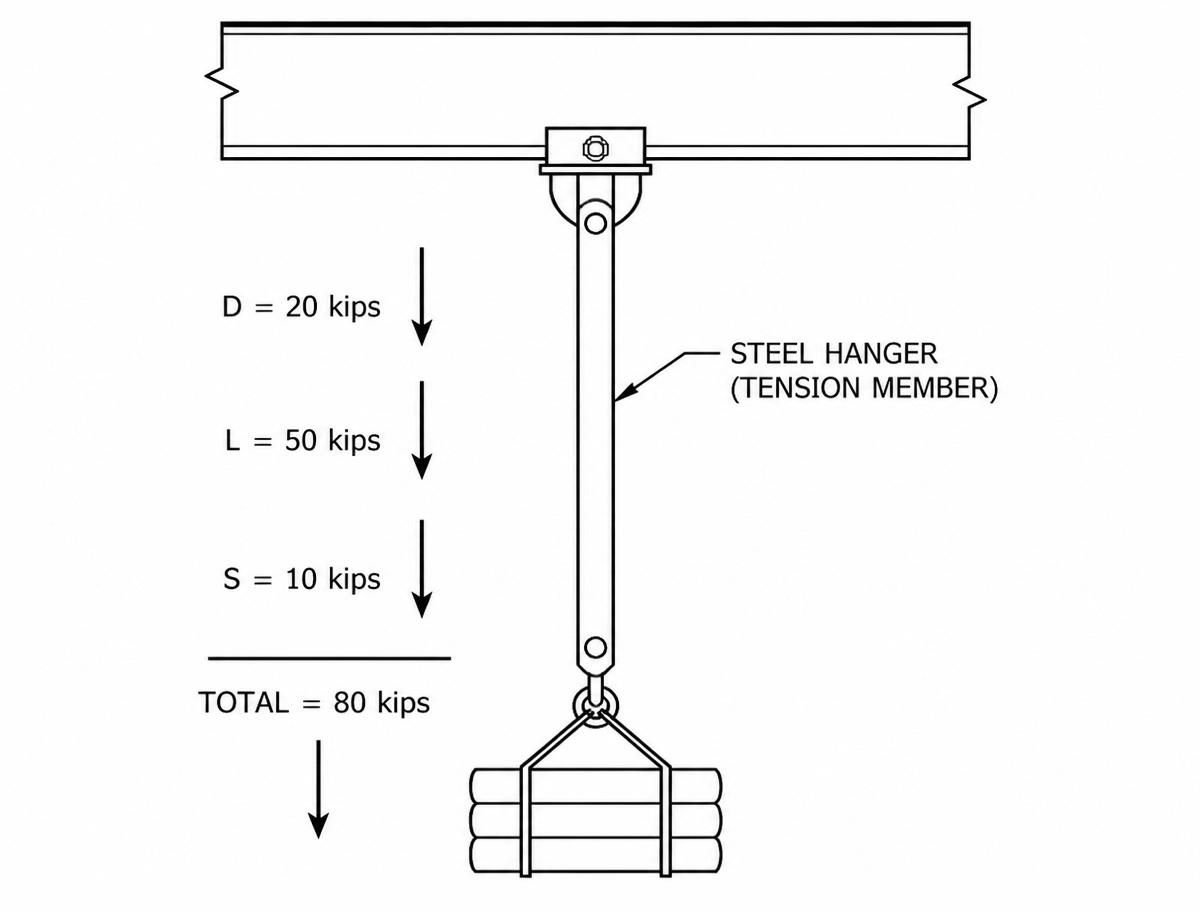
FE topic: Codes & Standards · ASCE 7 §2.3.1; AISC 360-22 §B2. Given D = 20 k, L = 50 k, S = 10 k on a tension hanger, find the controlling LRFD combination.
Problem statement
Given. D = 20 k, L = 50 k, S = 10 k acting on a tension hanger. Which ASCE 7-22 LRFD combination controls the required axial strength Pu?
Starting Example S1 — Tension hanger supporting D = 20 k, L = 50 k, S = 10 k.
Given
D = 20 k
L = 50 k
S = 10 k
Tension hanger — axial only
Find
Governing LRFD demand Pu
Assumptions
No wind or seismic governs here
Snow S is present (roof-supported hanger)
Code references
ASCE 7-22 §2.3.1 — LRFD load combinations
AISC 360-22 §B2 — Loads and load combinations
Step-by-step solution
1
Combo 1
1.4D = 1.4(20) = 28 k
2
Combo 2
1.2D + 1.6L + 0.5S = 24 + 80 + 5 = 109 k ★
3
Combo 3
1.2D + 1.6S + 0.5L = 24 + 16 + 25 = 65 k
Final answer
Answer: Pu = 109 k governs (Combo 2).
11
Guided practice
Compute the governing variables — hints unlock as you need them
Free-body diagram
A simply supported beam (L = 8 m) carries a 30 kN point load at midspan (a = 4 m). Determine the reactions R_A and R_B and confirm the result satisfies vertical equilibrium.
Your turn
Hints
1.Sketch the FBD: pin at A (R_A↑), roller at B (R_B↑), and P = 30 kN ↓ at midspan.
12
Independent practice
Solve the chapter's design task — compute each governing variable
Design task
A roof column carries service dead, live, and snow loads. Compute the LRFD gravity demand (Combo 2, 1.2D + 1.6L + 0.5S) and the ASD gravity demand (Combo 2, D + L).
Given
D = 45 kip
L = 60 kip
S = 25 kip
Approach
LRFD Combo 2: Pu = 1.2·D + 1.6·L + 0.5·(Lr or S or R). Snow is the companion here.
ASD Combo 2: Pa = D + L (snow does not appear in this combo).
Report Pu and Pa separately — LRFD and ASD are never added.
Submit your answer
13
Mini design challenge
Select the option that satisfies every code and serviceability requirement in the brief
Brief
Design a typical office-bay floor beam: L = 30 ft, tributary width = 10 ft, DL = 50 psf, LL = 50 psf. Screen W-shapes for strength (φ_bM_n ≥ M_u) AND serviceability (Δ_LL ≤ L/360) and pick the lightest satisfying section — the central 'design process' outcome for Chapter 1.
These questions reference AISC Steel Construction Manual (16th ed.) — sections, equations, and tables are cited explicitly. Use a calculator. Each question offers a clue you may reveal before answering. Submissions are recorded to your account once signed in.
C1-01AISC 360-22 §B
1. Which document is the primary specification governing structural steel building design in the US?
C1-02AISC Manual Part 1
2. In the AISC Manual (16th ed.), Part 1 tabulates:
C1-03AISC 360-22 §B3.1
3. LRFD design inequality is:
C1-04AISC 360-22 Ch. F
4. For a W-shape carrying pure bending, the primary member type per Ch. 1 classification is:
C1-05AISC 360-22 Ch. D & E
5. A truss chord in a roof truss is designed principally as a:
C1-06NIST NBS BSS 143
6. Which lesson best summarises the Hyatt Regency Kansas City walkway collapse (1981)?
C1-07AISC Manual Table 2-4
7. Steel grade A992 has minimum Fy and Fu of:
C1-08ASCE 7-22 Ch. 12
8. Wind and seismic loads on a low-rise moment frame are typically resisted by:
C1-09AISC 360-22 §L, ASCE 7 App. C
9. In LRFD, deflection is checked using:
C1-10Ch. 1 lecture
10. Which of these is NOT one of the four basic structural types (Ch.1)?
C1-11AISC 341-22 Table A3.1
11. A992 steel has expected yield ratio Ry (per AISC 341) equal to:
C1-12AISC 360-22 vs Manual 16
12. Which of these best describes the role of the AISC Manual vs the AISC Specification?
Attach your handwritten or typed step-by-step solution for this chapter's graded quiz. The instructor can download every submission. PDF only, up to 25 MB.
How your upload will be graded
Your file — PDF, Word document, scanned handwriting or a photo — is read page by page like an experienced structural engineering instructor would. The scan is validated first, then your reasoning, structural model, calculations, diagrams, code basis and final answers are graded on process, not just the final number. Design work is additionally reviewed against AISC 360-22 and ACI 318-19. Partial credit applies, and one early mistake carried correctly forward is only penalized once.
Before you attach the file
Include every page, in order and right way up — a missing page cannot earn credit.
Keep margins in frame: nothing cropped at the edges, especially boxed final answers.
Scan or photograph in good, even light — no shadows, glare or blur; 300 dpi or a steady phone scan.
Write in dark pen; faint pencil is the most common 'UNREADABLE — INSTRUCTOR REVIEW REQUIRED' flag.
Include all diagrams, FBDs, shear/moment diagrams and section sketches — label them.
Number each question the same way the assignment does, and note anything you skipped.
Show units on every line and box your final answers.
Combine everything into ONE file (PDF preferred; Word, JPG or PNG accepted) under 20 MB.
Sign in to upload your worked solution.
16
FE exam preparation
NCEES-style practice with timer, equation sheet, and mastery tracking

 Objective 01